


Page 338 - Demo
P. 338
13:11 The early Christians lived with a sense that Christ’s second coming was right around the corner. That awareness is clearly expressed here, as Paul urges the Romans to stay awake and arm themselves with “light” (13:12).
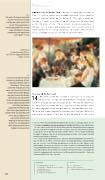
Luncheon of the Boating Party, by Pierre-Auguste Renoir (1841-1919)
14:1 Living in a blended Christian community, made up of both Jews and Gentiles, had its challenges. Those living under the new law of Christ were not bound to all the old observances of the Mosaic Law, particularly the dietary restrictions, but the Jewish Christians were not prepared to leave behind a way of life that they had always observed and held sacred. Here Paul urges people to be patient with one another, and not to “pass judgment” on each other, whether for keeping to the laws about food or for not keeping to them. Everyone must have freedom of conscience.
326
* [13:11–14] These verses provide the motivation for the love that is encouraged in Rom 13:8–10.
* [13:13] Let us conduct ourselves properly as in the day: the behavior described in Rom 1:29–30 is now to be reversed. Secular moralists were fond of making references to people who could not wait for nightfall to do their carousing. Paul says that Christians claim to be people of the new day that will dawn with the return of Christ. Instead of planning for nighttime behavior they should be concentrating on conduct that is consonant with
avowed interest in the Lord’s return.
* [14:1–15:6] Since Christ spells termination of the law, which included observance of speci c
days and festivals as well as dietary instruction, the jettisoning of long-practiced customs was traumatic for many Christians brought up under the Mosaic code. Although Paul acknowledges that in principle no food is a source of moral contamination (Rom 14:14), he recommends that the consciences of Christians who are scrupulous in this regard be respected by other Christians (Rom 14:21). On the other hand, those who have scruples are not to sit in judgment on those who know that the gospel has liberated them from such ordinances (Rom 14:10). See 1 Cor 8; 10.
CHAPTER 13
i. [13:11] Eph 5:8–16; 1 Thes 5:5–7.
j. [13:12] Jn 8:12; 1 Thes 5:4–8; 1 Jn 2:8 / 2 Cor 6:7;
10:4; Eph 5:11; 6:13–17.
k. [13:13] Lk 21:34; Eph 5:18.
l. [13:14] Gal 3:27; 5:16; Eph 4:24; 6:11.
CHAPTER 14
a. [14:1–23] 1 Cor 8:1–13.
b. [14:1] 15:1, 7; 1 Cor 9:22.
c. [14:2] Gn 1:29; 9:3; 1 Cor 8:1–13; 10:14–33.
ROMANS -
Awareness of the End of Time.* 11And do this because you know the time; it is the hour now for you to awake from sleep. For our salvation is nearer now than when we rst believed;i 12the night is advanced, the day is at hand. Let us then throw o the works of darkness [and] put on the armor of light;j 13let us conduct ourselves properly as in the day,* not in orgies and drunkenness, not in promiscuity and licentiousness, not in rivalry and jealousy.k 14But put on the Lord Jesus Christ, and make no provision for the desires of the esh.l
To Live and Die for Christ.
141* Welcome anyone who is weak in faith,a but not for disputes b2
over opinions. One person believes that one may eat anything, while the weak person eats only vegetables.c 3The one who eats must not despise the one who abstains, and the one who abstains must not pass judgment on the one who eats; for God has welcomed him.d 4Who are you to pass judgment on someone else’s servant? Before his own master he stands or falls. And he will be upheld, for the Lord is


