


Page 361 - Demo
P. 361
CORINTHIANS
9Paul’s Rights as an Apostle.
* 1Am I not free? Am I not an apostle? Have I not seen Jesus our
a2
Lord? Are you not my work in the Lord? Although I may not be
an apostle for others, certainly I am for you, for you are the seal of my apostleship in the Lord.
3My defense against those who would pass judgment on me* is this. 4* Do we not have the right to eat and drink? 5Do we not have the right to take along a Christian wife, as do the rest of the apostles, and the brothers of the Lord, and Cephas? 6Or is it only myself and Barnabas who do not have the right not to work?b 7Who ever serves as
a soldier at his own expense? Who plants a vineyard without eating its produce? Or who shepherds a ock without using
some of the milk from the ock?c 8Am I saying this on human authority, or does not the law also speak of these things? 9It is written in the law of Moses, “You shall not muzzle an ox while it
is treading out the grain.”d Is God concerned about oxen, 10or is
he not really speaking for our sake? It was written for our sake, because the plowman should plow in hope, and the thresher
in hope of receiving a share.e 11If we have sown spiritual seed
for you, is it a great thing that we reap a material harvest from
you?f 12If others share this rightful claim on you, do not we still more?g
Reason for Not Using His Rights. Yet we have not used this
right.* On the contrary, we endure everything so as not to place
an obstacle to the gospel of Christ. 13* Do you not know that
those who perform the temple services eat [what] belongs to
the temple, and those who minister at the altar share in the sacri cial o erings?h 14In the same way, the Lord ordered that
9:9
Paul cites Deuteronomy 25:4 to demonstrate that he would be within his rights to accept support from the community for the work he has done among them, but he has waived this right (9:12) to o er them the Gospel without any “obstacle” (9:13).
* [9:1–27] This chapter is an emotionally charged expansion of Paul’s appeal to his own example in 1 Cor 8:13; its purpose is to reinforce the exhortation of 1 Cor 8:9. The two opening questions introduce the themes of Paul’s freedom and his apostleship (1 Cor 9:1), themes that the chapter will develop in reverse order, 1 Cor 9:1–18 treating the question of his apostleship and the rights that ow from it, and 1 Cor 9:19–27 exploring dialectically the nature of Paul’s freedom. The language is highly rhetorical, abounding in questions, wordplays, paradoxes, images, and appeals to authority and experience. The argument is uni ed by repetitions; its articulations are highlighted by inclusions and transitional verses.
* [9:3] My defense against those who would pass judgment on me: the reference
to a defense (apologia) is surprising, and suggests that Paul is incorporating some
material here that he has previously used in another context. The defense will
touch on two points: the fact of Paul’s rights as an apostle (1 Cor 9:4–12a and 1 Cor 9:13–14) and his nonuse of those rights (1 Cor 9:12b and 1 Cor 9:15–18).
* [9:4–12a] Apparently some believe that Paul is not equal to the other apostles and therefore does not enjoy equal privileges. His defense on this point (here and in 1 Cor 9:13–14) reinforces the assertion of his apostolic character in 1 Cor 9:2. It consists of a series of analogies from natural equity (7) and religious custom (1 Cor 9:13) designed to establish his equal right to support from the churches (1 Cor 9:4–6, 11–12a); these analogies are con rmed by the authority of the law (1 Cor 9:8–10) and of Jesus himself (1 Cor 9:14).
* [9:12] It appears, too, that suspicion or misunderstanding has been created by Paul’s practice of not living from his preaching. The rst reason he asserts in defense of this practice is an entirely apostolic one; it anticipates the developments to follow in 1 Cor 9:19–22. He will give a second reason in 1 Cor 9:15–18.
* [9:13–14] The position of these verses produces an interlocking of the two points of Paul’s defense. These arguments by analogy (1 Cor 9:13) and from authority (1 Cor 9:14) belong with those of 1 Cor 9:7–10 and ground the rst point. But Paul defers them until he has had a chance to mention “the gospel of Christ” (1 Cor 9:12b), after which it is more appropriate to mention Jesus’ injunction to his preachers and to argue by analogy from the sacred temple service to his own liturgical service, the preaching of the gospel (cf. Rom 1:9; 15:16).
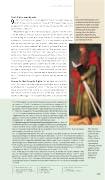
The Apostle Paul, by Lucas Cranach the Elder (1472- 1553). Paul is traditionally represented carrying a book, symbol of the Word of God, and sword, symbol of
the Spirit.
349
a. [9:1] 1 Cor 9:19 / 2 Cor 12:12 / 1 Cor 15:8–9 / Acts 9:17; 26:16.
b. [9:6] Acts 4:36–37; 13:1–2; Gal 2:1, 9, 13; Col 4:10.
c. [9:7] 2 Tm 2:3–4.
d. [9:9] Dt 25:4; 1 Tm 5:18. e. [9:10] 2 Tm 2:6.
f. [9:11] Rom 15:27.
g. [9:12] 2 Cor 11:7–12; 12:13–18; 2 Thes 3:6–12.
h. [9:13] Nm 18:8, 31; Dt 18:1–5.


