


Page 391 - Demo
P. 391
CORINTHIANS -
Call to Holiness. 14* Do not be yoked with those who are di erent, with
unbelievers.* For what partnership do righteousness and lawlessness 15
have? Or what fellowship does light have with darkness? What accord has Christ with Beliar? Or what has a believer in common with an unbeliever? 16l What agreement has the temple of God with idols? For we are the temple of the living God; as God said:
“I will live with them and move among them,* and I will be their God
and they shall be my people.
17Therefore, come forth from them and be separate,” says the Lord,
“and touch nothing unclean; then I will receive youm
18and I will be a father to you,
and you shall be sons and daughters to me,
says the Lord Almighty.”n
1Since we have these promises, beloved, let us cleanse ourselves
from every de lement of esh and spirit, making holiness perfect 7
in the fear of God.
2* Make room for us; we have not wronged anyone, or ruined anyone,
or taken advantage of anyone. 3I do not say this in condemnation, for I have already said that you are in our hearts, that we may die together and live together.a 4I have great con dence in you, I have great pride in you; I am lled with encouragement, I am over owing with joy all the more because of all our a iction.
C. RESOlUTION Of THE CRISIS*
Paul’s Joy in Macedonia. 5* For even when we came into Macedonia,* our esh had no rest, but we were a icted in every way—external con icts, internal fears.b 6But God, who encourages the downcast, encouraged us by the arrival of Titus,c 7and not only by his arrival but
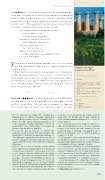
Remains of a pagan temple in Asia Minor
CHAPTER 6
l. [6:16] 1 Cor 10:20–21 / 1 Cor 3:16–17; 6:19 / Ex 25:8; 29:45; Lv 26:12; Jer 31:1; 32:38; Ez 37:27.
m.[6:17] Is 52:11; Ez 20:34, 41; Rev 18:4; 21:27.
n. [6:18] 2 Sm 7:14; Ps 2:7; Is 43:6; Jer 31:9; Rev 21:7 / Rev 4:8; 11:17; 15:3; 21:22.
CHAPTER 7
a. [7:3] 6:11–13.
b. [7:5] 2:13.
c. [7:6] 7:13–14; 1 Thes 3:6–8.
* [6:14–7:1] Language and thought shift noticeably here. Suddenly we are in a di erent atmosphere, dealing with a quite di erent problem. Both the vocabulary and the thought, with their contrast between good and evil, are more characteristic of Qumran documents or the Book of Revelation than they are of Paul. Hence, critics suspect that this section was inserted by another hand.
* [6:14–16a] The opening injunction to separate from unbelievers is reinforced by ve rhetorical questions to make the point that Christianity is not compatible with paganism. Their opposition is emphasized also by the accumulation of ve distinct designations for each group. These verses are a powerful statement of God’s holiness and the exclusiveness of his claims.
*[6:16c–18] This is a chain of scriptural citations carefully woven together. God’s covenant relation to his people and his presence among them (2 Cor 6:16) is seen as conditioned on cultic separation from the profane and cultically impure (2 Cor 6:17); that relation is translated into the personal language of the parent-child relationship, an extension to the community of the language of 2 Sm 7:14 (2 Cor 6:18). Some remarkable parallels to this chain are found in the nal chapters of Revelation. God’s presence among his people (Rev 21:22) is expressed there, too, by applying 2 Sm 7:14 to the community (Rev 21:7). There is a call to separation (Rev 18:4)
and exclusion of the unclean from the community and its liturgy (Rev 21:27). The title “Lord Almighty” (Pantokratōr) occurs in the New Testament only here in 2 Cor 6:18 and nine times in Revelation.
* [7:2–4] These verses continue the thought of 2 Cor 6:11–13, before the interruption of 2 Cor 6:14–7:1. 2 Cor 7:4 serves as a transition to the next section: the four themes it introduces (con dence; pride or “boasting”; encouragement; joy in a iction) are developed in 2 Cor 7:5–16. All have appeared previously in the letter.
* [7:5–16] This section functions as a peroration or formal summing up of the whole rst part of the letter, 2 Cor 1–7. It deals with the restoration of right relations between Paul and the Corinthians, and it is marked by fullness and intensity of emotion.
*[7:5–7]Paulpicksupthethreadofthenarrativeinterruptedat 2 Cor 2:13 (2 Cor 7:5) and describes the resolution of the tense situation there depicted (2 Cor 7:6–7). Finally Titus arrives and his coming puts an end to Paul’s restlessness (2 Cor 2:13; 2 Cor 7:5), casts out his fears, and reverses his mood. The theme of encouragement and a iction is reintroduced (cf. 2 Cor 1:3– 11); here, too, encouragement is traced back to God and is described as contagious (2 Cor 7:6). The language of joy and sorrow also reappears in 2 Cor 7:7 (cf. 2 Cor 1:23–2:1 and the note on 2 Cor 1:23–24).
* [7:5] Macedonia: see note on 2 Cor 2:13.
379


