


Page 397 - Demo
P. 397
CORINTHIANS
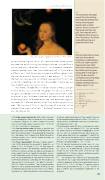
Eve, by Lucas Cranach the Elder (1472-1553)
you as a chaste virgin to Christ.b 3But I am afraid that, as the serpent deceived Eve* by his cunning, your thoughts may be corrupted from a sincere [and pure] commitment to Christ.c 4For if someone comes and preaches another Jesus* than the one we preached,d or if you receive a di erent spirit from the one you received or a di erent gospel from the one you accepted, you put up with it well enough. 5* e For I think that I am not in any way inferior to these “superapostles.” 6Even if I am untrained in speaking, I am not so in knowledge;f in every way we have made this plain to you in all things.*
Did I make a mistake when I humbled myself so that you might be exalted, because I preached the gospel of God to you without charge?g 8I plundered other churches by accepting from them in order to minister to you. 9And when I was with you and in need, I did not burden anyone, for the brothers who came from Macedonia supplied my needs. So I refrained and will refrain from burdening you in any way.h 10By the truth of Christ in me, this boast of mine shall not be silenced in the regions of Achaia.i 11* And why? Because I do not love you? God knows I do!j
7*
11:1
The Corinthians have been swayed from the teaching they originally received from Paul by some eloquent teachers who, in Paul’s opinion, “boast” too much of themselves and their own gifts. Paul responds with a self-defense which he says is mere “foolishness,” but which is valuable in giving us a glimpse of Paul’s story.
11:5
Paul satirically refers to those who have distorted the Corinthians’ understanding of Christ as “super-apostles.” He asserts his own rights within their community: he is like a father who has given his daughter in marriage to Christ. He fears that the Corinthians are turning away from this commitment, towards “another Jesus” or a “di erent Spirit” (11:4).
b. [11:2] Hos 2:21–22; Eph 5:26–27.
c. [11:3] Gn 3:1–6.
d. [11:4] Gal 1:6–9.
e. [11:5] 12:11.
f. [11:6] 1 Cor 1:5, 17; 2:1–5.
g. [11:7] 12:13–18; Acts 18:3; 1 Cor 9:6–18.
h. [11:9] Phil 4:15, 18.
i. [11:10] 1 Cor 9:15.
j. [11:11] 12:15.
* [11:3] As the serpent deceived Eve: before Christ can return for the community Paul fears a repetition of the primal drama of seduction. Corruption of minds is satanic activity (see 2 Cor 2:11; 4:4). Satanic imagery recurs in 2 Cor 11:13–15, 20; 12:7b, 16–17; see notes on these passages.
* [11:4] Preaches another Jesus: the danger is speci ed, and Paul’s opponents are identi ed with the cunning serpent. The battle for minds has to do with the understanding of Jesus, the Spirit, the gospel; the Corinthians have irted with another understanding than the one that Paul handed on to them as traditional and normative.
* [11:5] These “superapostles”: this term, employed again in 2 Cor 12:11b, designates the opponents of whom Paul has spoken in 2 Cor 10 and again in 2 Cor 11:4. They appear to be intruders at Corinth. Their preaching is marked at least by a di erent emphasis and style, and they do not hesitate to accept support from the community. Perhaps these itinerants appeal to the authority of church leaders in Jerusalem and even carry letters of recommendation from them. But it is not those distant leaders whom Paul is attacking here. The intruders are “superapostles” not in the sense of the “pillars” at Jerusalem (Gal 2), but in their own estimation. They consider themselves superior to Paul as apostles and ministers of Christ, and they are obviously enjoying some success among the Corinthians. Paul rejects their claim to be apostles in any superlative sense
(hyperlian), judging them bluntly as “false apostles,” ministers of Satan masquerading as apostles of Christ (2 Cor 11:13–15). On the contrary, he himself will claim to be a superminister of Christ (hyper egō, 2 Cor 11:23).
* [11:6] Apparently found de cient in both rhetorical ability (cf. 2 Cor 10:10) and knowledge (cf. 2 Cor 10:5), Paul concedes the former charge but not the latter. In every way: in all their contacts with him revelation has been taking place. Paul, through whom God reveals the knowledge of himself (2 Cor 2:14), and in whom the death and life of Jesus are revealed (2 Cor 4:10–11; cf. 2 Cor 6:4), also demonstrates his own role as the bearer of true knowledge. Cf. 1 Cor 1:18–2:16.
* [11:7–10] Abruptly Paul passes to another reason for com- plaints: his practice of preaching without remuneration (cf. 1 Cor 9:3–18). He deftly defends his practice by situating it from the start within the pattern of Christ’s own self- humiliation (cf. 2 Cor 10:1) and reduces objections to absurdity by rhetorical questions (cf. 2 Cor 12:13).
* [11:11–12] Paul rejects lack of a ection as his motive (possibly imputed to him by his opponents) and states his real motive, a desire to emphasize the disparity between himself and the others (cf. 2 Cor 11:19–21). The topic of his gratuitous service will be taken up once more in 2 Cor 12:13–18. 1 Cor 9:15–18 gives a di erent but complementary explanation of his motivation.
385


