


Page 400 - Demo
P. 400
12:14 After all the tension between Paul and this community, Paul is understandably nervous about his visit to Corinth. He prays that their fears and his will be dispelled when they meet.
CORINTHIANS
revelations. Therefore, that I might not become too elated,* a thorn in the esh was given to me, an angel of Satan, to beat me, to keep me from being too elated.b 8Three times* I begged the Lord about this, that it might leave me,c 9* but he said to me, “My grace is su cient for you, for power is made perfect in weakness.” I will rather boast most gladly of my weaknesses,* in order that the power of Christ may dwell with me.d 10Therefore, I am content with weaknesses, insults, hardships, persecutions, and constraints, for the sake of Christ;e for when I am weak, then I am strong.*
Sel ess Concern for the Church.* 11I have been foolish. You compelled me, for I ought to have been commended by you. For I am in no way inferior to these “superapostles,”f even though I am nothing. 12* The signs of an apostle were performed among you with all endurance, signs and wonders, and mighty deeds.g 13* In what way were you less privileged than the rest of the churches, except that on my part I did not burden you? Forgive me this wrong!h
14Now I am ready to come to you this third time. And I will not be a burden, for I want not what is yours, but you. Children ought not to save for their parents, but parents for their children. 15I will most gladly spend and be utterly spent for your sakes. If I love you more, am I to be loved less? 16But granted that I myself did not burden you, yet I was crafty and got the better of you by deceit.i 17Did I take advantage of you through any of those I sent to you? 18I urged Titus to go and sent the brother with him. Did Titus take advantage of you? Did we not walk in the same spirit? And in the same steps?j
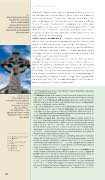
Celtic Cross. “For indeed he was cruci ed out of weakness, but he lives by the power of God.” The Sun Wheel – the Easter Sun – that adorns the Celtic crosses represents God’s victory over death.
b. [12:7] Nm 33:55; Jos 23:13; Ez 28:24.
c. [12:8] Mt 26:39–44.
d. [12:9] 4:7.
e. [12:10] 6:4–5; Rom 5:3 / Phil 4:13.
f. [12:11] 11:5.
g. [12:12] Rom 15:19; 1 Thes 1:5.
h. [12:13] 11:9–12.
i. [12:16] 11:3, 13.
j. [12:18] 2:13; 8:16, 23.
388
* [12:8] Three times: his prayer was insistent, like that of Jesus in Gethsemane, a sign of how intolerable he felt the thorn to be.
* [12:9] But he said to me: Paul’s petition is denied; release and healing are withheld for a higher purpose. The Greek perfect tense indicates that Jesus’ earlier response still holds at the time of writing. My grace is su cient for you: this is not a statement about the su ciency of grace in general. Jesus speaks directly to Paul’s situation. Is made perfect: i.e., is given most fully and manifests itself fully.
* [12:9b–10a] Paul draws the conclusion from the autobiographical anecdote and integrates it into the subject of this part of the boast. Weaknesses: the apostolic hardships he must endure, including active personal hostility, as speci ed in a nal catalogue (2 Cor 12:10a). That the power of Christ may dwell with me: Paul pinpoints the ground for the paradoxical strategy he has adopted in his self-defense.
* [12:10] When I am weak, then I am strong: Paul recognizes a twofold pattern in the resolution of the weakness-power (and death-life) dialectic, each of which looks to Jesus as the model and is experienced in him. The rst is personal, involving a reversal in oneself (Jesus, 2 Cor 13:4a; Paul, 2 Cor 1:9–10; 4:10–11; 6:9). The second is apostolic, involving an e ect on others (Jesus, 2 Cor 5:14–15; Paul, 2 Cor 1:6; 4:12; 13:9). The speci c kind of “e ectiveness in ministry” that Paul promises to demonstrate on his arrival (2 Cor 13:4b; cf. 2 Cor 10:1–11) involves elements of both; this, too, will be modeled on Jesus’ experience and a participation in that experience (2 Cor 9; 13:3b).
* [12:11–18] This brief section forms an epilogue or concluding observation to Paul’s boast, corresponding to the prologue in 2 Cor 11:1–15. A four-step sequence of ideas is common to these two sections: Paul quali es his boast as folly (2 Cor 11:1; 12:11a), asserts his noninferiority to the “superapostles” (2 Cor 11:5; 12:11b), exempli es this by allusion to charismatic endowments (2 Cor 11:6; 12:12), and nally denies that he has been a nancial burden to the community (2 Cor 11:7–12; 12:13–18).
* [12:12] Despite weakness and a iction (suggested by the mention of endurance), his ministry has been accompanied by demonstrations of power (cf. 1 Cor 2:3–4). Signs of an apostle: visible proof of belonging to Christ and of mediating Christ’s power, which the opponents require as touchstones of apostleship (2 Cor 12:11; cf. 2 Cor 13:3).
* [12:13–18] Paul insists on his intention to continue refusing support from the community (cf. 2 Cor 11:8–12). In defending his practice and his motivation, he once more protests his love (cf. 2 Cor 11:11) and rejects the suggestion of secret self-enrichment. He has recourse here again to language applied to his opponents earlier: “cunning” (2 Cor 11:3), “deceit” (2 Cor 11:13), “got the better of you” (see note on 2 Cor 11:20), “take advantage” (2 Cor 2:11).


