


Page 46 - Demo
P. 46
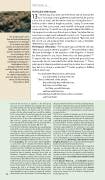
The word parable comes from a Greek word meaning “comparison” or “analogy.” It is a simple story which conveys a moral truth. Unlike fables, parables tend to be realistic and down-to-earth. Jesus’ teaching is full of memorable parables. In this chapter, he teaches about something extraordinary— the kingdom of God— through comparisons with ordinary things: seeds, weeds, wheat, yeast, pearls, nets. As simple as the parables of Jesus are, they are not always obvious in their meaning. They make us think.
MATTHEW
The Parable of the Sower.
131* On that day, Jesus went out of the house and sat down by the a2
sea. Such large crowds gathered around him that he got into a boat and sat down, and the whole crowd stood along the shore. 3* And he spoke to them at length in parables,* saying: “A sower went out to sow. 4And as he sowed, some seed fell on the path, and birds came and ate it up. 5Some fell on rocky ground, where it had little soil. It sprang up at once because the soil was not deep, 6and when the sun rose it was scorched, and it withered for lack of roots. 7Some seed fell among thorns, and the thorns grew up and choked it. 8But some seed fell on rich soil, and produced fruit, a hundred or sixty or thirtyfold. 9Whoever has ears ought to hear.”
The Purpose of Parables. 10The disciples approached him and said, “Why do you speak to them in parables?” 11* He said to them in reply, “Because knowledge of the mysteries of the kingdom of heaven has been granted to you, but to them it has not been granted. 12b To anyone who has, more will be given* and he will grow rich; from anyone who has not, even what he has will be taken away. 13* c This is why I speak to them in parables, because ‘they look but do not see and hear but do not listen or understand.’ 14d Isaiah’s prophecy is fulfilled in them, which says:
‘You shall indeed hear but not understand, you shall indeed look but never see.
15Gross is the heart of this people,
they will hardly hear with their ears, they have closed their eyes,
lest they see with their eyes and hear with their ears
and understand with their heart and be converted, and I heal them.’
*[13:1–53] The discourse in parables is the third great discourse of Jesus in Matthew and constitutes the second part of the third book of the gospel. Matthew follows the Marcan outline (Mk 4:1–35) but has only two of Mark’s parables, the ve others being from Q and M. In addition to the seven parables, the discourse gives the reason why Jesus uses this type of speech (Mt 13:10–15), declares the blessedness of those who understand his teaching (Mt 13:16–17), explains the parable of the sower (Mt 13:18–23) and of the weeds (Mt 13:36–43), and ends with a concluding statement to the disciples (Mt 13:51–52).
* [13:3–8] Since in Palestine sowing often preceded plowing, much of the seed is scattered on ground that is unsuitable. Yet while much is wasted, the seed that falls on good ground bears fruit in extraordinarily large measure. The point of the parable is that, in spite of some failure because of opposition and indi erence, the message of Jesus about the coming of the kingdom will have enormous success.
* [13:3] In parables: the word “parable” (Greek parabolē) is used in the LXX to translate the Hebrew māshāl, a designation covering a wide variety of literary forms such as axioms, proverbs, similitudes, and allegories. In the New Testament the same breadth of meaning of the word is found, but there it primarily designates stories that are illustrative comparisons between Christian truths and events of everyday life. Sometimes the event has a strange element that is quite di erent from usual experience (e.g., in Mt 13:33 the enormous amount of dough in the parable of the yeast); this is meant to sharpen the curiosity of the hearer. If each detail of such a story is given a gurative meaning, the story is an allegory. Those who maintain a sharp distinction between parable and allegory insist that a parable has only one point of comparison, and that while parables were characteristic of Jesus’ teaching, to see
allegorical details in them is to introduce meanings that go beyond their original intention and even falsify it. However, to exclude any allegorical elements from a parable is an excessively rigid mode of interpretation, now abandoned by many scholars.
* [13:11] Since a parable is gurative speech that demands re ection for understanding, only those who are prepared to explore its meaning can come to know it. To understand is a gift of God, granted to the disciples but not to the crowds. In Semitic fashion, both the disciples’ understanding and the crowd’s obtuseness are attributed to God. The question of human responsibility for the obtuseness is not dealt with, although it is asserted in Mt 13:13. The mysteries: as in Lk 8:10; Mk 4:11 has “the mystery.” The word is used in Dn 2:18, 19, 27 and in the Qumran literature (1QpHab 7:8; 1QS 3:23; 1QM 3:9) to designate a divine plan or decree a ecting the course of history that can be known only when revealed. Knowledge of the mysteries of the kingdom of heaven means recognition that the kingdom has become present in the ministry of Jesus.
* [13:12] In the New Testament use of this axiom of practical “wisdom” (see Mt 25:29; Mk 4:25; Lk 8:18; 19:26), the reference transcends the original level. God gives further understanding to one who accepts the revealed mystery; from the one who does not, he will take it away (note the “theological passive,” more will be given, what he has will be taken away).
* [13:13] Because ‘they look. . .or understand’: Matthew softens his Marcan source, which states that Jesus speaks in parables so that the crowds may not understand (Mk 4:12), and makes such speaking a punishment given because they have not accepted his previous clear teaching. However, his citation of Is 6:9–10 in Mt 13:14 supports the harsher Marcan view.
34


