


Page 49 - Demo
P. 49
MATTHEW
Treasures New and Old. 51“Do you understand* all these things?” They answered, “Yes.” 52* And he replied, “Then every scribe who has been instructed in the kingdom of heaven is like the head of a household who brings from his storeroom both the new and the old.” 53When Jesus finished these parables, he went away from there.
V. JESUS, THE KINGDOM, AND THE CHURCH
The Rejection at Nazareth. 54* He came to his native place and taught the people in their synagogue.p They were astonished* and said, “Where did this man get such wisdom and mighty deeds?q 55Is he not the carpenter’s son? Is not his mother named Mary and his brothers James, Joseph, Simon, and Judas?r 56Are not his sisters all with us? Where did this man get all this?” 57And they took offense at him. But Jesus said to them, “A prophet is not without honor except in his native place and in his own house.”s 58And he did not work many mighty deeds there because of their lack of faith.
* [13:51] Matthew typically speaks of the understanding of the disciples.
* [13:52] Since Matthew tends to identify the disciples and the Twelve (see note on Mt 10:1), this saying about the Christian scribe cannot be taken as applicable to all who accept the message of Jesus. While the Twelve are in many ways representative of all who believe in him, they are also distinguished from them in certain respects. The church of Matthew has leaders among whom are a group designated as “scribes” (Mt 23:34). Like the scribes of Israel, they are teachers. It is the Twelve and these their later counterparts to whom this verse applies. The scribe. . .instructed in the kingdom of heaven knows both the teaching of Jesus (the new) and the law and prophets (the old) and provides in his own teaching both the new and the old as interpreted and ful lled by the new. On the translation head of a household (for the same Greek word translated householder in Mt
13:27), see note on Mt 24:45–51.
* [13:54–17:27] This section is the narrative part of the fourth book of the gospel.
* [13:54–58] After the Sermon on the Mount the crowds are in admiring astonishment at
Jesus’ teaching (Mt 7:28); here the astonishment is of those who take o ense at him. Familiarity with his background and family leads them to regard him as pretentious. Matthew modi es his Marcan source (Mt 6:1–6). Jesus is not the carpenter but the carpenter’s son (Mt 13:55), “and among his own kin” is omitted (Mt 13:57), he did not work many mighty deeds in face of such unbelief (Mt 13:58) rather than the Marcan “. . .he was not able to perform any mighty deed there” (Mt 6:5), and there is no mention of his amazement at his townspeople’s lack of faith.
p. [13:54–58] Mk 6:1–6; Lk 4:16–30. q. [13:54] 2:23; Jn 1:46; 7:15.
r. [13:55] 12:46; 27:56; Jn 6:42. s. [13:57] Jn 4:44.
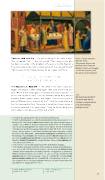
Piero Lorenzo Monaco: Herod’s Feast.
The painter depicts the moment when John the Baptist’s head was brought
to Salome in front of all the guests at the banquet.
13:55
Did Jesus have brothers? The word may refer to brothers, to step-brothers, or to near relatives, perhaps cousins.
37


