


Page 72 - Demo
P. 72
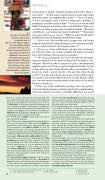
23:2 Jesus does not reject the teaching of those who “occupy the chair of Moses”—the religious leaders of his day. But he sharply condemns their hypocrisy, for they do not practice what they preach, and they are indi erent to the needs of the people who carry the “heavy burdens” of the Law (23:4). For those who follow Jesus, there must be a new kind of servant leadership, characterized by compassion and total integrity.
MATTHEW
and lay them on people’s shoulders, but they will not lift a finger to move them. 5* c All their works are performed to be seen. They widen their phylacteries and lengthen their tassels. 6* d They love places of honor at banquets, seats of honor in synagogues, 7greetings in marketplaces, and the salutation ‘Rabbi.’ 8* As for you, do not be called ‘Rabbi.’You have but one teacher, and you are all brothers. 9Call no one on earth your father; you have but one Father in heaven. 10Do not be called ‘Master’; you have but one master, the Messiah. 11e The greatest among you must be your servant. 12f Whoever exalts himself will be humbled; but whoever humbles himself will be exalted.
13* g “Woe to you, scribes and Pharisees, you hypocrites. You lock the kingdom of heaven* before human beings. You do not enter yourselves, nor do you allow entrance to those trying to enter. [14]*
15* “Woe to you, scribes and Pharisees, you hypocrites. You traverse sea and land to make one convert, and when that happens you make him a child of Gehenna twice as much as yourselves.
16* h “Woe to you, blind guides, who say, ‘If one swears by the temple, it means nothing, but if one swears by the gold of the temple, one is obligated.’ 17Blind fools, which is greater, the gold, or the temple that made the gold sacred? 18And you say, ‘If one swears by the altar, it means nothing, but if one swears by the gift on the altar, one is obligated.’ 19You blind ones, which is greater, the gift, or the altar that makes the gift sacred? 20i One who swears by the altar swears by it and all that is upon it; 21one who swears by the temple swears by it and by him who dwells in it; 22one who swears by heaven swears by the throne of God and by him who is seated on it.
23j “Woe to you, scribes and Pharisees, you hypocrites. You pay tithes* of mint and dill and cummin, and have neglected the weightier things of the law: judgment and mercy and fidelity. [But] these you should
* [23:5] To the charge of preaching but not practicing (Mt 23:3), Jesus adds that of acting in order to earn praise. The disciples have already been warned against this same fault (see note on Mt 6:1– 18). Phylacteries: the Mosaic law required that during prayer small boxes containing parchments on which verses of scripture were written be worn on the left forearm and the forehead (see Ex 13:9, 16; Dt 6:8; 11:18). Tassels: see note on Mt 9:20. The widening of phylacteries and the lengthening of tassels were for the purpose of making these evidences of piety more noticeable.
* [23:6–7] Cf. Mk 12:38–39. ‘Rabbi’: literally, “my great one,” a title of respect for teachers and leaders.
* [23:8–12] These verses, warning against the use of various titles, are addressed to the disciples alone. While only the title ‘Rabbi’ has been said to be used in addressing the scribes and Pharisees (Mt 23:7), the implication is that Father and ‘Master’ also were. The prohibition of these titles to the disciples suggests that their use was present in Matthew’s church. The Matthean Jesus forbids not only the titles but the spirit of superiority and pride that is shown by their acceptance. Whoever exalts. . .will be exalted: cf. Lk 14:11.
* [23:13–36] This series of seven “woes,” directed against the scribes and Pharisees and addressed to them, is the heart of the speech. The phrase woe to occurs often in the prophetic and apocalyptic literature, expressing horror of a sin and punishment for those who commit it. Hypocrites: see note on Mt 6:2. The hypocrisy of the scribes and Pharisees consists in the di erence between their speech and action (Mt 23:3) and in demonstrations of piety that have no other purpose than to enhance their reputation as religious persons (Mt 23:5).
* [23:13] You lock the kingdom of heaven: cf. Mt 16:19 where Jesus tells Peter that he will give him the keys to the kingdom of heaven. The purpose of the authority expressed by that metaphor is to give entrance into the kingdom (the kingdom is closed only to those who reject the authority); here the charge is made that the
authority of the scribes and Pharisees is exercised in such a way as to be an obstacle to entrance. Cf. Lk 11:52 where the accusation against the “scholars of the law” (Matthew’s scribes) is that they “have taken away the key of knowledge.”
* [23:14] Some manuscripts add a verse here or after Mt 23:12, “Woe to you, scribes and Pharisees, you hypocrites. You devour the houses of widows and, as a pretext, recite lengthy prayers. Because of this, you will receive a very severe condemnation.” Cf. Mk 12:40; Lk 20:47. This “woe” is almost identical with Mk 12:40 and seems to be an interpolation derived from that text.
* [23:15] In the rst century A.D. until the First Jewish Revolt against Rome (A.D. 66–70), many Pharisees conducted a vigorous missionary campaign among Gentiles. Convert: literally, “pro- selyte,” a Gentile who accepted Judaism fully by submitting to circumcision and all other requirements of Mosaic law. Child of Gehenna: worthy of everlasting punishment; for Gehenna, see note on Mt 5:22. Twice as much as yourselves: possibly this refers simply to the zeal of the convert, surpassing that of the one who converted him.
* [23:16–22] An attack on the casuistry that declared some oaths binding (one is obligated) and others not (it means nothing) and held the binding oath to be the one made by something of lesser value (the gold; the gift on the altar). Such teaching, which inverts the order of values, reveals the teachers to be blind guides; cf. Mt 15:14. Since the Matthean Jesus forbids all oaths to his disciples (Mt 5:33–37), this woe does not set up a standard for Christian moral conduct, but ridicules the Pharisees on their own terms.
* [23:23] The Mosaic law ordered tithing of the produce of the land (Lv 27:30; Dt 14:22–23), and the scribal tradition is said here to have extended this law to even the smallest herbs. The practice is criticized not in itself but because it shows the Pharisees’ preoccupation with matters of less importance while they neglect the weightier things of the law.
60
c. [23:5] 6:1–6; Ex 13:9, 16; Nm 15:38–39; Dt 6:8; 11:18. e. [23:11] 20:26. g. [23:13] Lk 11:52. d. [23:6–7] Mk 12:38–39; Lk 11:43; 20:46. f. [23:12] Lk 14:11; 18:14. h. [23:16] 15:14.
i. [23:20–22] 5:34–35.


