


Page 74 - Demo
P. 74
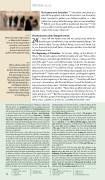
23:37 There are many images of God as father in the Scriptures: here we see an image of God as mother. Jesus loves his people even as a mother hen loves her chicks and gathers them under her wing.
24:3 When will the world end? Jesus does not answer his disciples directly, but he tells them not to be lled with fear, but simply to trust in the unfolding of God’s plan. The devastating events that a ict the human family— earthquakes, famines, wars—are not endings but beginnings, “birthpangs” (24:8) that herald the coming of something new.
MATTHEW -
The Lament over Jerusalem.* 37r “Jerusalem, Jerusalem, you who kill the prophets and stone those sent to you, how many times I yearned to gather your children together, as a hen gathers her young under her wings, but you were unwilling!s 38t Behold, your house will be abandoned, desolate. 39u I tell you, you will not see me again until you say, ‘Blessed is he who comes in the name of the Lord.’”
The Destruction of the Temple Foretold.
241* a Jesus left the temple area and was going away, when his 2*
disciples approached him to point out the temple buildings. He said to them in reply, “You see all these things, do you not? Amen, Isay to you, there will not be left here a stone upon another stone that will not be thrown down.”
The Beginning of Calamities. 3As he was sitting on the Mount of Olives,* the disciples approached him privately and said, “Tell us, when will this happen, and what sign will there be of your coming, and of the end of the age?” 4* Jesus said to them in reply, “See that no one deceives you. 5For many will come in my name, saying, ‘I am the Messiah,’ and they will deceive many. 6b You will hear of wars* and reports of wars; see that you are not alarmed, for these things must happen, but it will not yet be the end. 7c Nation will rise against nation, and kingdom against kingdom; there will be famines and earthquakes from place to place. 8* All these are the beginning of the labor pains. 9* d Then they will hand you over to persecution, and they will kill you. You will be hated by all nations because of my name. 10And then many will be led into sin; they will betray and hate one another. 11Many false prophets will arise and deceive many; 12and because of the increase of evildoing, the love of many will grow cold. 13e But the one who perseveres to the end will be saved. 14f And this gospel of the kingdom will be preached throughout the world as a witness to all nations,* and then the end will come.
* [23:37–39] Cf. Lk 13:34–35. The denunciation of Pharisaic Judaism ends with this lament over Jerusalem, which has repeatedly rejected and murdered those whom God has sent to her. How many times: this may refer to various visits of Jesus to the city, an aspect of his ministry found in John but otherwise not in the synoptics. As a hen. . .under her wings: for imagery similar to this, see Ps 17:8; 91:4. Your house. . .desolate: probably an allusion to the destruction of the temple in A.D. 70. You will not see me. . .in the name of the Lord: Israel will not see Jesus again until he comes in glory for the nal judgment. The acclamation has been interpreted in contrasting ways, as an indication that Israel will at last accept Jesus at that time, and as its troubled recognition of him as its dreaded judge who will pronounce its condemnation; in support of the latter view see Mt 24:30.
* [24:1–25:46] The discourse of the fth book, the last of the ve around which the gospel is structured. It is called the “eschatological” discourse since it deals with the coming of the new age (the eschaton) in its fullness, with events that will precede it, and with how the disciples are to conduct themselves while awaiting an event that is as certain as its exact time is unknown to all but the Father (Mt 24:36). The discourse may be divided into two parts, Mt 24:1–44 and Mt 24:45–25:46. In the rst, Matthew follows his Marcan source (Mk 13:1– 37) closely. The second is drawn from Q and from the evangelist’s own traditional material. Both parts show Matthew’s editing of his sources by deletions, additions, and modi cations. The vigilant waiting that is emphasized in the second part does not mean a cessation of ordinary activity and concentration only on what is to come, but a faithful accomplishment of duties at hand, with awareness that the end, for which the disciples must always be ready, will entail the great judgment by which the everlasting destiny of all will be determined.
* [24:2] As in Mark, Jesus predicts the destruction of the temple. By
omitting the Marcan story of the widow’s contribution (Mk 12:41–44) that immediately precedes the prediction in that gospel, Matthew has established a close connection between it and Mt 23:38, “. . .your house will be abandoned desolate.”
* [24:3] The Mount of Olives: see note on Mt 21:1. The disciples: cf. Mk 13:3–4 where only Peter, James, John, and Andrew put the question that is answered by the discourse. In both gospels, however, the question is put privately: the ensuing discourse is only for those who are disciples of Jesus. When will this happen...end of the age?: Matthew distinguishes carefully between the destruction of the temple (this) and the coming of Jesus that will bring the end of the age. In Mark the two events are more closely connected, a fact that may be explained by Mark’s believing that the one would immediately succeed the other. Coming: this translates the Greek word parousia, which is used in the gospels only here and in Mt 24:27, 37, 39. It designated the o cial visit of a ruler to a city or the manifestation of a saving deity, and it was used by Christians to refer to the nal coming of Jesus in glory, a term rst found in the New Testament with that meaning in 1 Thes 2:19. The end of the age: see note on Mt 13:39.
* [24:4–14] This section of the discourse deals with calamities in the world (Mt 24:6–7) and in the church (Mt 24:9–12). The former must happen before the end comes (Mt 24:6), but they are only the beginning of the labor pains (Mt 24:8). (It may be noted that the Greek word translated the end in Mt 24:6 and in Mt 24:13–14 is not the same as the phrase “the end of the age” in Mt 24:3, although the meaning is the same.) The latter are su erings of the church, both from within and without, that will last until the gospel is preached. . .to all nations. Then the end will come and those who have endured the su erings with delity will be saved (Mt 24:13–14).
62
Chapter 23
r. [23:37–39] Lk 13:34–35;
19:41–44.
s. [23:37] 21:35.
t. [23:38] Jer 12:7. u. [23:39] Ps 118:26.
Chapter 24
a. [24:1–44] Mk 13:1–37; Lk 21:5–36. b. [24:6] Dn 2:28 LXX.
c. [24:7] Is 19:2.
d. [24:9] 10:17.
e. [24:13] 10:22.
f. [24:14] 28:19; Rom 10:18.


