


Page 75 - Demo
P. 75
MATTHEW
The Great Tribulation.* 15g “When you see the desolating abomination* spoken of through Daniel the prophet standing in the holy place (let the reader understand), 16then those in Judea must flee* to the mountains, 17* h a person on the housetop must not go down to get things out of his house, 18a person in the field must not return to get his cloak. 19Woe to pregnant women and nursing mothers in those days. 20* Pray that your flight not be in winter or on the sabbath, 21* i for at that time there will be great tribulation, such as
has not been since the beginning of the world until now, nor ever will be. 22And if those days had not been shortened, no one would be saved; but for the sake of the elect they will be shortened. 23j If anyone says to you then, ‘Look, here is the Messiah!’ or, ‘There he is!’ do not believe it. 24False messiahs and false prophets will arise, and they will perform signs and wonders so great as to deceive, if that were possible, even the elect. 25Behold, I have told it to you beforehand. 26So if they say to you, ‘He is in the desert,’ do not go out there; if they say, ‘He is in the inner rooms,’ do not believe it.* 27k For just as lightning comes from the east and is seen as far as the west, so will the coming of the Son of Man be. 28Wherever the corpse is, there the vultures will gather.
Apocalyptic writing:
Jesus’ teaching about the
end times is part of a long prophetic tradition. The prophets Amos, Malachi, and especially Daniel also describe the end times with vivid imagery and metaphor.
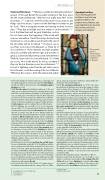
The prophet Daniel, stained-glass window of the Cathedral
of Bourges
* [24:6–7] The disturbances mentioned here are a commonplace of apocalyptic language, as is the assurance that they must happen (see Dn 2:28 LXX), for that is the plan of God. Kingdom against kingdom: see Is 19:2.
* [24:8] The labor pains: the tribulations leading up to the end of the age are compared to the pains of a woman about to give birth. There is much attestation for rabbinic use of the phrase “the woes (or birth pains) of the Messiah” after the New Testament period, but in at least one instance it is attributed to a rabbi who lived in the late rst century A.D. In this Jewish usage it meant the distress of the time preceding the coming of the Messiah; here, the labor pains precede the coming of the Son of Man in glory.
* [24:9–12] Matthew has used Mk 13:9–12 in his missionary discourse (Mt 10:17–21) and omits it here. Besides the su erings, including death, and the hatred of all nations that the disciples will have to endure, there will be worse a iction within the church itself. This is described in Mt 24:10–12, which are peculiar to Matthew. Will be led into sin: literally, “will be scandalized,” probably meaning that they will become apostates; see Mt 13:21 where “fall away” translates the same Greek word as here. Betray: in the Greek this is the same word as the hand over of Mt 24:9. The handing over to persecution and hatred from outside will have their counterpart within the church. False prophets: these are Christians; see note on Mt 7:15–20. Evildoing: see Mt 7:23. Because of the apocalyptic nature of much of this discourse, the literal meaning of this description of the church should not be pressed too hard. However, there is reason to think that Matthew’s addition of these verses re ects in some measure the condition of his community.
* [24:14] Except for the last part (and then the end will come), this verse substantially repeats Mk 13:10. The Matthean addition raises a problem since what follows in Mt 24:15–23 refers to the horrors of the First Jewish Revolt including the destruction of the temple, and Matthew, writing after that time, knew that the parousia of Jesus was still in the future. A solution may be that the evangelist saw the events of those verses as foreshadowing the cosmic disturbances that he associates with the parousia (Mt 24:29) so that the period in which the former took place could be understood as belonging to the end.
* [24:15–28] Cf. Mk 13:14–23; Lk 17:23–24, 37. A further stage in the tribulations that will precede the coming of the Son of Man,
g. [24:15] Dn 9:27; 11:31; 12:11; Mk 13:14. h. [24:17] Lk 17:31.
i. [24:21] Dn 12:1.
and an answer to the question of Mt 24:3a, “when will this (the
destruction of the temple) happen?”
* [24:15] The desolating abomination: in 167 B.C. the Syrian
king Antiochus IV Epiphanes desecrated the temple by setting up in it a statue of Zeus Olympios (see 1 Mc 1:54). That event is referred to in Dn 12:11 LXX as the “desolating abomination” (NAB “horrible abomination”) and the same Greek term is used here; cf. also Dn 9:27; 11:31. Although the desecration had taken place before Daniel was written, it is presented there as a future event, and Matthew sees that “prophecy” ful lled in the desecration of the temple by the Romans. In the holy place: the temple; more precise than Mark’s where he should not (Mk 13:14). Let the reader understand: this parenthetical remark, taken from Mk 13:14 invites the reader to realize the meaning of Daniel’s “prophecy.”
* [24:16] The tradition that the Christians of Jerusalem ed from that city to Pella, a city of Transjordan, at the time of the First Jewish Revolt is found in Eusebius (Ecclesiastical History, 3.5.3), who attributes the ight to “a certain oracle given by revelation before the war.”The tradition is not improbable but the Matthean command, derived from its Marcan source, is vague in respect to the place of ight (to the mountains), although some scholars see it as applicable to the ight to Pella.
* [24:17–19] Haste is essential, and the journey will be particularly di cult for women who are burdened with unborn or infant children. * [24:20] On the sabbath: this addition to in winter (cf. Mk 13:18) has been understood as an indication that Matthew was addressed to a church still observing the Mosaic law of sabbath rest and the scribal limitations upon the length of journeys that might lawfully be made on that day. That interpretation con icts with Matthew’s view on sabbath observance (cf. Mt 12:1–14). The meaning of the addition may be that those undertaking on the sabbath a journey such as the one here ordered would be o ending the sensibilities of law-observant Jews and would
incur their hostility.
* [24:21] For the unparalleled distress of that time, see Dn 12:1.
* [24:26–28] Claims that the Messiah is to be found in some
distant or secret place must be ignored. The coming of the Son of Man will be as clear as lightning is to all and as the corpse of an animal is to vultures; cf. Lk 17:24, 37. Here there is clear identi cation of the Son of Man and the Messiah; cf. Mt 24:23.
j. [24:23] Lk 17:23.
k. [24:27–28] Lk 17:24, 37.
63


