


Page 76 - Demo
P. 76
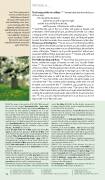
Jesus’ rst coming was in secret, in the little town of Bethlehem, in the quiet obscurity of the stable, yet it was heralded by a star. Jesus’ second coming will be “like lightning striking in the east and ashing far into the west,” visible to every eye. Yet it will come suddenly, “at an hour you do not expect” (24:44). We must be cautious and watchful and learn to read the signs of the times.
MATTHEW
The Coming of the Son of Man. 29* l “Immediately after the tribulation of those days,
the sun will be darkened,
and the moon will not give its light,
and the stars will fall from the sky,
and the powers of the heavens will be shaken.
30m And then the sign of the Son of Man* will appear in heaven, and all the tribes of the earth will mourn, and they will see the Son of Man coming upon the clouds of heaven with power and great glory. 31n And he will send out his angels* with a trumpet blast, and they will gather his elect from the four winds, from one end of the heavens to the other. The Lesson of the Fig Tree.* 32“Learn a lesson from the fig tree. When its branch becomes tender and sprouts leaves, you know that summer is near. 33In the same way, when you see all these things, know that he is near, at the gates. 34Amen, I say to you, this generation* will not pass away until all these things have taken place. 35o Heaven and earth will pass away, but my words will not pass away.
The Unknown Day and Hour.* 36p “But of that day and hour no one knows, neither the angels of heaven, nor the Son,* but the Father alone. 37* q For as it was in the days of Noah, so it will be at the coming of the Son of Man. 38In [those] days before the flood, they were eating and drinking, marrying and giving in marriage, up to the day that Noah entered the ark. 39They did not know until the flood came and carried them all away. So will it be [also] at the coming of the Son of Man. 40* r Two men will be out in the field; one will be taken, and one will be left. 41Two women will be grinding at the mill; one will be taken, and one will be left. 42* s Therefore, stay awake! For you do not know on which day your Lord will come. 43t Be sure of this: if the master of the house had known the hour of night when the thief was coming, he would have stayed awake and not let his house be broken into. 44So too, you also must be prepared, for at an hour you do not expect, the Son of Man will come.
* [24:29] The answer to the question of Mt 24:3b, “What sign will there be of your coming?” Immediately after. . .those days: the shortening of time between the preceding tribulation and the parousia has been explained as Matthew’s use of a sup- posed device of Old Testament prophecy whereby certainty that a predicted event will occur is expressed by depicting it as imminent. While it is questionable that that is an acceptable understanding of the Old Testament predictions, it may be applicable here, for Matthew knew that the parousia had not come immediately after the fall of Jerusalem, and it is unlikely that he is attributing a mistaken calculation of time to Jesus. The sun. . .be shaken: cf. Is 13:10, 13.
* [24:30] The sign of the Son of Man: perhaps this means the sign that is the glorious appearance of the Son of Man; cf. Mt 12:39–40 where “the sign of Jonah” is Jonah’s being in the “belly of the whale.” Tribes of the earth will mourn: peculiar to Matthew; cf. Zec 12:12–14. Coming upon the clouds. . .glory: cf. Dn 7:13, although there the “one like a son of man” comes to God to receive kingship; here the Son of Man comes from heaven for judgment.
* [24:31] Send out his angels: cf. Mt 13:41 where they are sent out to collect the wicked for punishment. Trumpet blast: cf. Is 27:13; 1 Thes 4:16.
* [24:32–35] Cf. Mk 13:28–31.
* [24:34] The di culty raised by this verse cannot be satisfactorily
removed by the supposition that this generation means the Jewish people throughout the course of their history, much less the entire human race. Perhaps for Matthew it means the generation to which he and his community belonged.
* [24:36–44] The statement of Mt 24:34 is now counterbalanced by one that declares that the exact time of the parousia is known
only to the Father (Mt 24:36), and the disciples are warned to be always ready for it. This section is drawn from Mark and Q (cf. Lk 17:26–27, 34–35; 12:39–40).
* [24:36] Many textual witnesses omit nor the Son, which follows Mk 13:32. Since its omission can be explained by reluctance to attribute this ignorance to the Son, the reading that includes it is probably original.
* [24:37–39] Cf. Lk 17:26–27. In the days of Noah: the Old Testament account of the ood lays no emphasis upon what is central for Matthew, i.e., the unexpected coming of the ood upon those who were unprepared for it.
*
* *
*
*
[24:40–41] Cf. Lk 17:34–35. Taken. . .left: the former probably means taken into the kingdom; the latter, left for destruction. People in the same situation will be dealt with in opposite ways. In this context, the discrimination between them will be based on their readiness for the coming of the Son of Man.
[24:42–44] Cf. Lk 12:39–40. The theme of vigilance and readiness is continued with the bold comparison of the Son of Man to a thief who comes to break into a house.
[24:45–51] The second part of the discourse (see note on Mt 24:1–25:46) begins with this parable of the faithful or un- faithful servant; cf. Lk 12:41–46. It is addressed to the leaders of Matthew’s church; the servant has been put in charge of his master’s household (Mt 24:45) even though that household is composed of those who are his fellow servants (Mt 24:49). [24:45] To distribute. . .proper time: readiness for the master’s return means a vigilance that is accompanied by faithful per- formance of the duty assigned.
[24:48] My master. . .delayed: the note of delay is found also in the other parables of this section; cf. Mt 25:5, 19.
64
l. [24:29] Is 13:10, 13; Ez 32:7; Am 8:9.
m. [24:30] Dn 7:13; Zec 12:12–14; Rev 1:7. n. [24:31] Is 27:13; 1 Cor 15:52; 1 Thes 4:16.
o. [24:35] Is 40:8.
p. [24:36] Acts 1:7.
q. [24:37–39] Gn 6:5–7:23; Lk 17:26–27; 2 Pt 3:6.
r. [24:40–41] Lk 17:34–35.
s. [24:42–44] 25:13; Lk 12:39–40.
t. [24:43] 1 Thes 5:2.u. [24:45–51] Lk 12:41–46.


