


Page 78 - Demo
P. 78
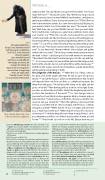
25:31 Throughout Matthew’s Gospel, Jesus identi es himself with his people (see Matthew 10:40, 18:5). In this nal and climactic parable, Jesus identi es himself with the poor and a icted: the hungry, the thirsty, the stranger, the naked, the imprisoned. In serving them, we serve him. In neglecting them, we neglect him. “You did it to me” (25:40): it is a summary of the Gospel.
Here, Giotto depicts the risen Christ at the Last Judgment.
MATTHEW
additional five.* He said, ‘Master, you gave me five talents. See, I have made five more.’ 21d His master said to him, ‘Well done, my good and faithful servant. Since you were faithful in small matters, I will give you great responsibilities. Come, share your master’s joy.’ 22[Then] the one who had received two talents also came forward and said, ‘Master, you gave me two talents. See, I have made two more.’ 23His master said to him, ‘Well done, my good and faithful servant. Since you were faith- ful in small matters, I will give you great responsibilities. Come, share your master’s joy.’ 24Then the one who had received the one talent came forward and said, ‘Master, I knew you were a demanding person, harvesting where you did not plant and gathering where you did not scatter; 25so out of fear I went off and buried your talent in the ground. Here it is back.’ 26His master said to him in reply, ‘You wicked, lazy ser- vant!* So you knew that I harvest where I did not plant and gather where I did not scatter? 27Should you not then have put my money in the bank so that I could have got it back with interest on my return? 28Now then! Take the talent from him and give it to the one with ten. 29* e For to everyone who has, more will be given and he will grow rich; but from the one who has not, even what he has will be taken away. 30* And throw this useless servant into the darkness outside, where there will be wailing and grinding of teeth.’
The Judgment of the Nations.* 31f “When the Son of Man comes in his glory, and all the angels with him, he will sit upon his glorious throne, 32g and all the nations* will be assembled before him. And he will separate them one from another, as a shepherd separates the sheep from the goats. 33He will place the sheep on his right and the goats on his left. 34Then the king will say to those on his right, ‘Come, you who are blessed by my Father. Inherit the kingdom prepared for you from the foundation of the world. 35h For I was hungry and you gave me food, I was thirsty and you gave me drink, a stranger and you welcomed me, 36naked and you clothed me, ill and you cared for me, in prison and you visited me.’ 37Then the righteous* will answer him and say, ‘Lord, when did we see you hungry and feed you, or thirsty and give you drink? 38When did we see you a stranger and welcome you, or naked and clothe you? 39When did we see you ill or in prison, and visit you?’ 40i And the king will say to them in reply, ‘Amen, I say to you, whatever you did for one of these least brothers of mine, you did for me.’ 41* j Then he will say to those on his left, ‘Depart from me, you
* [25:26–28] Wicked, lazy servant: this man’s inactivity is not negligible but seriously culpable. As punishment, he loses the gift he had received, that is now given to the rst servant, whose possessions are already great.
* [25:29] See note on Mt 13:12 where there is a similar application of this maxim.
* [25:30] See note on Mt 8:11–12.
* [25:31–46] The conclusion of the discourse, which is peculiar to
Matthew, portrays the nal judgment that will accompany the parousia. Although often called a “parable,” it is not really such, for the only parabolic elements are the depiction of the Son of Man as a shepherd and of the righteous and the wicked as sheep and goats, respectively (Mt 25:32–33). The criterion of judgment will be the deeds of mercy that have been done for the least of Jesus’ brothers (Mt 25:40). A di cult and important question is the identi cation of these least brothers. Are they all people who have su ered hunger, thirst, etc. (Mt 25:35, 36) or a particular group of such su erers? Scholars are divided in their response and arguments can be made for either side. But leaving aside the problem of what the traditional material that Matthew edited may have meant, it seems that a stronger
case can be made for the view that in the evangelist’s sense the su erers are Christians, probably Christian missionaries whose su erings were brought upon them by their preaching of the gospel. The criterion of judgment for all the nations is their treatment of those who have borne to the world the message of Jesus, and this means ultimately their acceptance or rejection of Jesus himself; cf. Mt 10:40, “Whoever receives you, receives me.” See note on Mt 16:27.
* [25:32] All the nations: before the end the gospel will have been preached throughout the world (Mt 24:14); thus the Gentiles will be judged on their response to it. But the phrase all the nations includes the Jews also, for at the judgment “the Son of Man. . .will repay everyone according to his conduct” (Mt 16:27).
* [25:37–40] The righteous will be astonished that in caring for the needs of the su erers they were ministering to the Lord himself. One of these least brothers of mine: cf. Mt 10:42.
* [25:41] Fire prepared. . .his angels: cf. 1 Enoch 10:13 where it is said of the evil angels and Semyaza, their leader, “In those days they will lead them into the bottom of the re—and in torment—in the prison (where) they will be locked up forever.”
..d. [25:21] Lk 16:10.
e. [25:29] 13:12; Mk 4:25; Lk 8:18; 19:26. 66 f. [25:31] 16:27; Dt 33:2 LXX.
g. [25:32] Ez 34:17.
h. [25:35–36] Is 58:7; Ez 18:7. i. [25:40] 10:40, 42.
j. [25:41] 7:23; Lk 13:27.


