


Page 80 - Demo
P. 80
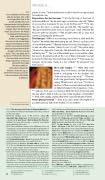
26:17 Jesus celebrates the Passover with his disciples. One of the most important days in the Jewish calendar, Passover commemorates the night when God brought the Israelites out of Egypt, when the destroying angel “passed over” the houses marked with the blood of a lamb, and destroyed the rstborn of the Egyptians. Passover is both a meal and a ritual of remembrance. In this context, Jesus takes bread and wine and shares them with his disciples, with the stunning words “This is my body; this is my blood.” He himself is the new Passover lamb, whose blood brings forgiveness of sins and eternal life. Every day,
Christians gather to remember, to break the bread, to share the cup, to meet Christ living in our midst in the sacrament of his Body and Blood.
1 From the Exsultet, Roman Missal.
MATTHEW
pieces of silver, 16and from that time on he looked for an opportunity to hand him over.
Preparations for the Passover. 17g On the first day of the Feast of Unleavened Bread,* the disciples approached Jesus and said, “Where do you want us to prepare for you to eat the Passover?”h 18* He said, “Go into the city to a certain man and tell him, ‘The teacher says, “My appointed time draws near; in your house I shall celebrate the Passover with my disciples.”’” 19The disciples then did as Jesus had ordered, and prepared the Passover.
The Betrayer. 20When it was evening, he reclined at table with the Twelve. 21And while they were eating, he said, “Amen, I say to you, one of you will betray me.”* 22Deeply distressed at this, they began to say to him one after another, “Surely it is not I, Lord?” 23He said in reply, “He who has dipped his hand into the dish with me is the one who will betray me. 24* i The Son of Man indeed goes, as it is written of him, but woe to that man by whom the Son of Man is betrayed. It would be better for that man if he had never been born.” 25* Then Judas, his betrayer, said in reply, “Surely it is not I, Rabbi?” He answered, “You have said so.”
The Lord’s Supper. 26* j While they were eating, Jesus took bread, said the blessing, broke it, and giving it to his disciples said, “Take and eat; this is my body.”* k 27Then he took a cup, gave thanks,* and gave it to them, saying, “Drink from it, all of you, 28l for this is my blood of the covenant, which will be shed on behalf of many for the forgiveness of sins.
29* I tell you, from now on I shall not drink this fruit of the vine until the day when I drink it with you new in the kingdom of my Father.” 30* Then, after singing a hymn, they went out to the Mount of Olives. Peter’s Denial Foretold. 31m Then Jesus said to them, “This night all of you will have your faith in me shaken,* for it is written:n
* [26:17] The rst day of the Feast of Unleavened Bread: see note on Mk 14:1. Matthew omits Mark’s “when they sacri ced the Passover lamb.”
* [26:18] By omitting much of Mk 14:13–15, adding My appointed time draws near, and turning the question into a statement, in your house I shall celebrate the Passover, Matthew has given this passage a solemnity and majesty greater than that of his source.
* [26:21] Given Matthew’s interest in the ful llment of the Old Testament, it is curious that he omits the Marcan designation of Jesus’ betrayer as “one who is eating with me” (Mk 14:18), since that is probably an allusion to Ps 41:10. However, the shocking fact that the betrayer is one who shares table fellowship with Jesus is emphasized in Mt 26:23.
* [26:24] It would be better. . .born: the enormity of the deed is such that it would be better not to exist than to do it.
* [26:25] Peculiar to Matthew. You have said so: cf. Mt 26:64; 27:11. This is a half-a rmative. Emphasis is laid on the pronoun and the answer implies that the statement would not have been made if the question had not been asked.
* [26:26–29] See note on Mk 14:22–24. The Marcan-Matthean is one of the two major New Testament traditions of the words of Jesus when instituting the Eucharist. The other (and earlier) is the Pauline-Lucan (1 Cor 11:23–25; Lk 22:19–20). Each shows the in uence of Christian liturgical usage, but the Marcan- Matthean is more developed in that regard than the Pauline- Lucan. The words over the bread and cup succeed each other without the intervening meal mentioned in 1 Cor 11:25; Lk
22:20; and there is parallelism between the consecratory words (this is my body. . .this is my blood). Matthew follows Mark closely but with some changes.
* [26:26] See note on Mt 14:19. Said the blessing: a prayer blessing God. Take and eat: literally, Take, eat. Eat is an addition to Mark’s “take it” (literally, “take”; Mk 14:22). This is my body: the bread is identi ed with Jesus himself.
* [26:27–28] Gave thanks: see note on Mt 15:36. Gave it to them. . .all of you: cf. Mk 14:23–24. In the Marcan sequence the disciples drink and then Jesus says the interpretative words. Matthew has changed this into a command to drink followed by those words. My blood: see Lv 17:11 for the concept that the blood is “the seat of life” and that when placed on the altar it “makes atonement.” Which will be shed: the present participle, “being shed” or “going to be shed,” is future in relation to the Last Supper. On behalf of: Greek peri; see note on Mk 14:24. Many: see note on Mt 20:28. For the forgiveness of sins: a Matthean addition. The same phrase occurs in Mk 1:4 in connection with John’s baptism but Matthew avoids it there (Mt 3:11). He places it here probably because he wishes to emphasize that it is the sacri cial death of Jesus that brings forgiveness of sins.
* [26:29] Although his death will interrupt the table fellowship he has had with the disciples, Jesus con dently predicts his vindication by God and a new table fellowship with them at the banquet of the kingdom.
* [26:30] See note on Mk 14:26.
* [26:31] Will have. . .shaken: literally, “will be scandalized in me”;
see note on Mt 24:9–12. I will strike. . .dispersed: cf. Zec 13:7.
g. [26:17–25] Mk 14:12–21; Lk 22:7–23.
h. [26:17] Ex 12:14–20. 68 i. [26:24] Is 53:8–10.
j. [26:26–30] Mk 14:22–26; Lk 22:14–23; 1 Cor 11:23–25.
k. [26:26–27] 1 Cor 10:16.
l. [26:28] Ex 24:8; Is 53:12. m. [26:31–35] Mk 14:7–31. n. [26:31] Zec 13:7; Jn 16:32.


