


Page 81 - Demo
P. 81
MATTHEW
‘I will strike the shepherd,
and the sheep of the flock will be dispersed’;
32but after I have been raised up, I shall go before you to Galilee.” 33Peter said to him in reply, “Though all may have their faith in you shaken, mine will never be.” 34* o Jesus said to him, “Amen, I say to you, this very night before the cock crows, you will deny me three
times.”p 35Peter said to him, “Even though I should have to
die with you, I will not deny you.” And all the disciples spoke likewise.
The Agony in the Garden. 36* q Then Jesus came with them to
a place called Gethsemane,* and he said to his disciples, “Sit here while I go over there and pray.”r 37s He took along Peter and the two sons of Zebedee,* and began to feel sorrow and distress. 38t Then he said to them, “My soul is sorrowful even to death.* Remain here and keep watch with me.” 39u He advanced a little and fell prostrate in prayer, saying, “My Father,* if it is possible, let this cup pass from me; yet, not as I will, but as you will.” 40When he returned to his disciples he found them asleep. He said to Peter, “So you could not keep watch with me for one hour? 41Watch and pray that you may not undergo the test.* The spirit is willing, but the flesh is weak.” 42* v Withdrawing a second time, he prayed again, “My Father, if it is not possible that this cup pass without my drinking it, your
will be done!” 43Then he returned once more
and found them asleep, for they could not
keep their eyes open. 44He left them and
withdrew again and prayed a third time,
saying the same thing again. 45w Then he
returned to his disciples and said to them,
“Are you still sleeping and taking your rest?
Behold, the hour is at hand when the Son of
Man is to be handed over to sinners. 46Get
up, let us go. Look, my betrayer is at hand.”
26:30
Jesus and his disciples sing psalms together before leaving the table. What songs, what pieces of music, have allowed you to express or to deepen your faith?
26:36
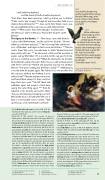
Before su ering his
physical agony on the cross, Jesus su ers
spiritual agony. He wants his friends to be close to him. He shrinks from the su ering
that lies ahead and begs God to nd another way, to spare him this “cup” he must drink.
And yet he trusts, praying again and again the prayer he taught his disciples:
“Your will be done” (6:10).
Jesus in the Garden of Gethsemane, by Eugene Delacroix
* [26:34] Before the cock crows: see note on Mt 14:25. The third watch of the night was called “cockcrow.” Deny me: see note on Mt 16:24.
* [26:36–56] Cf. Mk 14:32–52. The account of Jesus in Gethsemane is divided between that of his agony (Mt 26:36– 46) and that of his betrayal and arrest (Mt 26:47–56). Jesus’ sorrow and distress (Mt 26:37) in face of death is unrelieved by the presence of his three disciples who, though urged to watch with him (Mt 26:38, 41), fall asleep (Mt 26:40, 43). He prays that if. . .possible his death may be avoided (Mt 26:39) but that his Father’s will be done (Mt 26:39, 42, 44). Knowing then that his death must take place, he announces to his companions that the hour for his being handed over has come (Mt 26:45). Judas arrives with an armed band provided by the Sanhedrin and greets Jesus with a kiss, the prearranged sign for his identi cation (Mt 26:47–49). After his arrest, he rebukes a disciple who has attacked the high priest’s servant with a sword (Mt 26:51–54), and chides those who have come out to seize him with swords and clubs as if he were a robber (Mt 26:55–56). In both rebukes Jesus declares that the treatment he is now receiving is the ful llment of the scriptures (Mt 26:55, 56). The subsequent ight of all the disciples is itself the ful llment of his own prediction (cf. 31). In this episode, Matthew follows Mark with a few alterations.
* [26:36] Gethsemane: the Hebrew name means “oil press” and designates an olive orchard on the western slope of the
Mount of Olives; see note on Mt 21:1. The name appears only
in Matthew and Mark. The place is called a “garden” in Jn 18:1. * [26:37] Peter and the two sons of Zebedee: cf. Mt 17:1.
* [26:38] Cf. Ps 42:6, 12. In the Septuagint (Ps 41:5, 12) the
same Greek word for sorrowful is used as here. To death: i.e.,
“enough to die”; cf. Jon 4:9.
* [26:39] My Father: see note on Mk 14:36. Matthew omits the
Aramaic ’abbā’ and adds the quali er my. This cup: see note
on Mk 10:38–40.
* [26:41] Undergo the test: see note on Mt 6:13. In that verse
“the nal test” translates the same Greek word as is here translated the test, and these are the only instances of the use of that word in Matthew. It is possible that the passion of Jesus is seen here as an anticipation of the great tribulation that will precede the parousia (see notes on Mt 24:8; 24:21) to which Mt 6:13 refers, and that just as Jesus prays to be delivered from death (Mt 26:39), so he exhorts the disciples to pray that they will not have to undergo the great test that his passion would be for them. Some scholars, however, understand not undergo (literally, “not enter”) the test as meaning not that the disciples may be spared the test but that they may not yield to the temptation of falling away from Jesus because of his passion even though they will have to endure it.
* [26:42] Your will be done: cf. Mt 6:10.
u. [26:39] Jn 4:34; 6:38; Phil 2:8.
v. [26:42] 6:10; Heb 10:9.
w. [26:45] Jn 12:23; 13:1; 17:1. 69
o. [26:34–35] Lk 22:33–34; Jn 13:37–38. p. [26:34] 26:69–75.
q. [26:36–46] Mk 14:32–42; Lk 22:39–46.
r. [26:36] Jn 18:1.
s. [26:37–39] Heb 5:7.
t. [26:38] Ps 42:6, 12; Jon 4:9.


