


Page 82 - Demo
P. 82
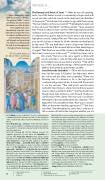
26:48 Jesus is betrayed by Judas with mock respect—the kiss, the greeting “rabbi”—and is arrested by an armed crowd. But when one of his disciples tries to ght back, Jesus immediately stops him. Jesus will indeed conquer the forces of violence and hate, but not with a military victory. He will triumph not by avoiding the darkness, but by passing through it and emerging into the light of Easter morning.
The Very Rich Hours of the Duc de Berry, Limbourg (15th century)
MATTHEW
The Betrayal and Arrest of Jesus. 47x While he was still speaking, Judas, one of the Twelve, arrived, accompanied by a large crowd, with swords and clubs, who had come from the chief priests and the elders of the people. 48His betrayer had arranged a sign with them, saying, “ThemanIshallkissistheone;arresthim.”49Immediatelyhewentover to Jesus and said, “Hail, Rabbi!”* and he kissed him. 50Jesus answered him, “Friend, do what you have come for.” Then stepping forward they laid hands on Jesus and arrested him. 51And behold, one of those who accompanied Jesus put his hand to his sword, drew it, and struck the high priest’s servant, cutting off his ear. 52Then Jesus said to him, “Put your sword back into its sheath, for all who take the sword will perish by the sword. 53Do you think that I cannot call upon my Father and he will not provide me at this moment with more than twelve legions of angels? 54But then how would the scriptures be fulfilled which say that it must come to pass in this way?” 55* At that hour Jesus said to
the crowds, “Have you come out as against a robber, with swords and clubs to seize me? Day after day I sat teaching in the temple area, yet you did not arrest me. 56y But all this has come to pass that the writings of the prophets may be fulfilled.”Then all the disciples left him and fled.
Jesus Before the Sanhedrin.* 57z Those who had arrested Jesus led him away to Caiaphas* the high priest, where the scribes and the elders were assembled. 58Peter was following him at a distance as far as the high priest’s courtyard, and going inside he sat down with the servants to see the outcome. 59The chief priests and the entire Sanhedrin* kept trying to obtain false testimony against Jesus in order to put him to death, 60a but they found none, though many false witnesses came forward. Finally two* came forward 61who stated, “This man said, ‘I can destroy the temple of God and within three days rebuild it.’” 62The high priest rose and addressed him, “Have you no answer? What are these men testifying against you?” 63b But Jesus
was silent.* Then the high priest said to him, “I order you to tell us under oath before the living God whether you are
* [26:49] Rabbi: see note on Mt 23:6–7. Jesus is so addressed twice in Matthew (Mt 26:25), both times by Judas. For the signi cance of the closely related address “teacher” in Matthew, see note on Mt 8:19.
* [26:55] Day after day. . .arrest me: cf. Mk 14:49. This suggests that Jesus had taught for a relatively long period in Jerusalem, whereas Mt 21:1–11 puts his coming to the city for the rst time only a few days before.
* [26:57–68] Following Mk 14:53–65 Matthew presents the nighttime appearance of Jesus before the Sanhedrin as a real trial. After many false witnesses bring charges against him that do not su ce for the death sentence (Mt 26:60), two came forward who charge him with claiming to be able to destroy the temple. . .and within three days to rebuild it (Mt 26:60–61). Jesus makes no answer even when challenged to do so by the high priest, who then orders him to declare under oath. . .whether he is the Messiah, the Son of God (Mt 26:62–63). Matthew changes Mark’s clear a rmative response (Mk 14:62) to the same one as that given to Judas (Mt 26:25), but follows Mark almost verbatim in Jesus’ predicting that his judges will see him (the Son of Man) seated at the right hand of God and coming on the clouds of heaven (Mt 26:64). The high priest then charges him with blasphemy (Mt 26:65), a charge with which the other members of the Sanhedrin agree by declaring that he deserves to die (Mt 26:66). They then attack him (Mt 26:67) and mockingly demand that he prophesy
(Mt 26:68). This account contains elements that are contrary to the judicial procedures prescribed in the Mishnah, the Jewish code of law that dates in written form from ca. A.D. 200, e.g., trial on a feast day, a night session of the court, pronouncement of a verdict of condemnation at the same session at which testimony was received. Consequently, some scholars regard the account entirely as a creation of the early Christians without historical value. However, it is disputable whether the norms found in the Mishnah were in force at the time of Jesus. More to the point is the question whether the Matthean-Marcan night trial derives from a combination of two separate incidents, a nighttime preliminary investigation (cf. Jn 18:13, 19–24) and a formal trial on the following morning (cf. Lk 22:66–71).
* [26:57] Caiaphas: see note on Mt 26:3.
* [26:59] Sanhedrin: see note on Lk 22:66.
* [26:60–61] Two: cf. Dt 19:15. I can destroy. . .rebuild it: there
are signi cant di erences from the Marcan parallel (Mk 14:58). Matthew omits “made with hands” and “not made with hands” and changes Mark’s “will destroy” and “will build another” to can destroy and (can) rebuild. The charge is probably based on Jesus’ prediction of the temple’s destruction; see notes on Mt 23:37–39; 24:2; and Jn 2:19. A similar prediction by Jeremiah was considered as deserving death; cf. Jer 7:1–15; 26:1–8.
* [26:63] Silent: possibly an allusion to Is 53:7. I order you. . . living God: peculiar to Matthew; cf. Mk 14:61.
70
x. [26:47–56] Mk 14:43–50; Lk 22:47–53;
Jn 18:3–11.
y. [26:56] 26:31. a. [26:60–61] Dt 19:15; Jn 2:19; Acts 6:14. z. [26:57–68] Mk 14:53–65; b. [26:63] Is 53:7.
Lk 22:54–55, 63–71; Jn 18:12–14, 19–24.


