


Page 86 - Demo
P. 86
27:46 Jesus cries out from the cross with words from Psalm 22: “My God, my God, why have you abandoned me? / Why so far from my call for help, / from my cries of anguish? / My God, I call by day, but you do not answer; / by night, but I have no relief”” (Psalm 22: 2-3).
27:55 Though Peter and the other apostles ed, Jesus is not entirely abandoned. Faithful women keep watch with him as he dies, and Joseph of Arimathea makes sure that his body is buried with reverence.
MATTHEW
from the cross now, and we will believe in him. 43* s He trusted in God; let him deliver him now if he wants him. For he said, ‘I am the Son of God.’” 44The revolutionaries who were crucified with him also kept abusing him in the same way.
The Death of Jesus. 45* t From noon onward,u darkness came over the whole land until three in the afternoon. 46v And about three o’clock Jesus cried out in a loud voice, “Eli, Eli, lema sabachthani?”* which means, “My God, my God, why have you forsaken me?” 47* Some of the bystanders who heard it said, “This one is calling for Elijah.” 48w Immediately one of them ran to get a sponge; he soaked it in wine, and putting it on a reed, gave it to him to drink. 49But the rest said, “Wait, let us see if Elijah comes to save him.” 50* But Jesus cried out again in a loud voice, and gave up his spirit. 51x And behold, the veil of the sanctuary was torn in two from top to bottom.* The earth quaked, rocks were split, 52y tombs were opened, and the bodies of
many saints who had fallen asleep were raised. 53And coming forth from their tombs after his resurrection, they entered the holy city and appeared to many. 54* The centurion and the men with him who were keeping watch over Jesus feared greatly when they saw the earthquake and all that was happening, and they said, “Truly, this was the Son of God!” 55There were many women there, looking on from a distance,* who had followed Jesus from Galilee, ministering to him. 56z Among them were Mary Magdalene and Mary the mother
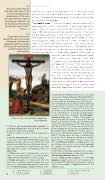
..Christ on the Cross and Mary Magdalene, Luca Signorelli
* [27:43] Peculiar to Matthew. He trusted in God. . .wants him: cf. Ps 22:9. He said...of God: probably an allusion to Wis 2:12–20 where the theme of the su ering Just One appears.
* [27:45] Cf. Am 8:9 where on the day of the Lord “the sun will set at midday.”
* [27:46] Eli, Eli, lema sabachthani?: Jesus cries out in the words of Ps 22:2a, a psalm of lament that is the Old Testament passage most frequently drawn upon in this narrative. In Mark the verse is cited entirely in Aramaic, which Matthew partially retains but changes the invocation of God to the Hebrew Eli, possibly because that is more easily related to the statement of the following verse about Jesus’ calling for Elijah.
* [27:47] Elijah: see note on Mt 3:4. This prophet, taken up into heaven (2 Kgs 2:11), was believed to come to the help of those in distress, but the evidences of that belief are all later than the gospels.
* [27:50] Gave up his spirit: cf. the Marcan parallel (Mk 15:37), “breathed his last.” Matthew’s alteration expresses both Jesus’ control over his destiny and his obedient giving up of his life to God.
* [27:51–53] Veil of the sanctuary. . .bottom: cf. Mk 15:38; Lk 23:45.
Luke puts this event immediately before the death of Jesus. There were two veils in the Mosaic tabernacle on the model of which the temple was constructed, the outer one before the entrance of the Holy Place and the inner one before the Holy of Holies (see Ex 26:31– 36). Only the high priest could pass through the latter and that only on the Day of Atonement (see Lv 16:1–18). Probably the torn veil of the gospels is the inner one. The meaning of the scene may be that now, because of Jesus’ death, all people have access to the presence of God, or that the temple, its holiest part standing exposed, is now profaned and will soon be destroyed. The earth quaked... appeared to many: peculiar to Matthew. The earthquake, the splitting of the rocks, and especially the resurrection of the dead saints indicate the coming of the nal age. In the Old Testament the coming of God is frequently portrayed with the imagery of an
earthquake (see Ps 68:9; 77:19), and Jesus speaks of the earthquakes that will accompany the “labor pains” that signify the beginning of the dissolution of the old world (Mt 24:7–8). For the expectation of the resurrection of the dead at the coming of the new and nal age, see Dn 12:1–3. Matthew knows that the end of the old age has not yet come (Mt 28:20), but the new age has broken in with the death (and resurrection; cf. the earthquake in Mt 28:2) of Jesus; see note on Mt 16:28. After his resurrection: this quali cation seems to be due to Matthew’s wish to assert the primacy of Jesus’ resurrection even though he has placed the resurrection of the dead saints immediately after Jesus’ death.
* [27:54] Cf. Mk 15:39. The Christian confession of faith is made by Gentiles, not only the centurion, as in Mark, but the other soldiers who were keeping watch over Jesus (cf. Mt 27:36).
*[27:55–56] Looking on from a distance: cf. Ps 38:12. Mary Magdalene. . .Joseph: these two women are mentioned again in Mt 27:61 and Mt 28:1 and are important as witnesses of the reality of the empty tomb. A James and Joseph are referred to in Mt 13:55 as brothers of Jesus.
74
s. [27:43] Ps 22:9; Wis 2:12–20. t. [27:45–46] Mk 15:33–41;
Lk 23:44–49; Jn 19:28–30.
u. [27:45] Am 8:9. v. [27:46] Ps 22:2. w. [27:48] Ps 69:21.
x. [27:51] Ex 26:31–36; Ps 68:9; 77:19. y. [27:52] Dn 12:1–3.
z. [27:56] 13:55.


