


Page 98 - Demo
P. 98
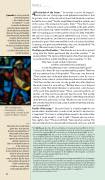
A parable is a story in which something familiar —the sowing of seed, for example—is used to reveal a truth about something quite unfamiliar, like the presence and action of God in the world. Parables often have vivid, memorable imagery and an element of mystery: they stick in the mind and make us think. No key is provided to explain the parable; rather, it is left to the hearer to sort out the meaning.
This contemporary stained-glass window comes from a church in the region of Alsace, France.
4:10 Only when the crowds have gone does Jesus give his disciples an explanation of the parable of the sower. The sower is the one who spreads the word of God, sharing it generously. But not everyone receives it in the same way. Some will be enthusiastic for a time and then lose interest, while in others the word will get crowded out by other concerns. But for those who welcome the word of God in a deeper way, it will be a source of life in amazing abundance.
86
MARK 4The Parable of the Sower. 1* On another occasiona he began to *teach by the sea. A very large crowd gathered around him so that he got into a boat on the sea and sat down. And the whole crowd was beside the sea on land.b 2And he taught them at length in parables, and in the course of his instruction he said to them, 3* “Hear this! A sower went out to sow. 4And as he sowed, some seed fell on the path, and the birds came and ate it up. 5Other seed fell on rocky ground where it had little soil. It sprang up at once because the soil was not deep. 6And when the sun rose, it was scorched and it withered for lack of roots. 7Some seed fell among thorns, and the thorns grew up and choked it and it produced no grain. 8And some seed fell on rich soil and produced fruit. It came up and grew and yielded thirty, sixty, and a hundredfold.” 9He added, “Whoever has ears to hear ought to hear.”
The Purpose of the Parables. 10And when he was alone, those present
along with the Twelve questioned him about the parables. 11* He answered them, “The mystery of the kingdom of God has been granted to you. But to those outside everything comes in parables, 12so that
‘they may look and see but not perceive,
and hear and listen but not understand,
in order that they may not be converted and be forgiven.’”c 13* Jesus said to them, “Do you not understand this parable?d Then how will you understand any of the parables? 14The sower sows the word. 15These are the ones on the path where the word is sown. As soon as they hear, Satan comes at once and takes away the word sown in them. 16And these are the ones sown on rocky ground who, when they hear the word, receive it at once with joy. 17But they have no root; they last only for a time. Then when tribulation or persecution comes because of the word, they quickly fall away. 18Those sown among thorns are another sort. They are the people who hear the word, 19but worldly anxiety, the lure of riches, and the craving for other things intrude and choke the word, and it bears no fruit. 20But those sown on rich soil are the ones who hear the word and accept it and bear fruit thirty and sixty and a hundredfold.”
Parable of the Lamp. 21e He said to them, “Is a lamp brought in to be placed under a bushel basket or under a bed, and not to be placed on a lampstand?f 22For there is nothing hidden except to be made visible; nothing is secret except to come to light.g 23Anyone who has ears to hear ought to hear.” 24He also told them, “Take care what you hear. The measure with which you measure will be measured out to you, and still
......* [4:1] By the sea: the shore of the Sea of Galilee or a boat near the shore (Mk 2:13; 3:7–8) is the place where Mark depicts Jesus teaching the crowds. By contrast the mountain is the scene of Jesus at prayer (Mk 6:46) or in the process of forming his disciples (Mk 3:13; 9:2).
* [4:1–34] In parables (Mk 4:2): see note on Mt 13:3. The use of parables is typical of Jesus’ enigmatic method of teaching the crowds (Mk 4:2–9, 12) as compared with the interpretation of the parables he gives to his disciples (Mk 4:10–25, 33–34) to each group according to its capacity to understand (Mk 4:9–11). The key feature of the parable at hand is the sowing of the seed (Mk 4:3), representing the breakthrough of the kingdom of God into the world. The various types of soil refer to the diversity of response accorded the word of God (Mk 4:4–7). The climax of the parable is the harvest of thirty, sixty, and a hundredfold, indicating the consummation of the kingdom (Mk 4:8). Thus both the present and the future action of God, from the initiation to the ful llment of the kingdom, is presented through this and other parables (Mk 4:26–29, 30–32).
* [4:3–8] See note on Mt 13:3–8.
* [4:11–12] These verses are to be viewed against their background in Mk 3:6, 22 concerning the
unbelief and opposition Jesus encountered in his ministry. It is against this background that the distinction in Jesus’ method becomes clear of presenting the kingdom to the disbelieving crowd in one manner and to the disciples in another. To the former it is presented in parables and the truth remains hidden; for the latter the parable is interpreted and the mystery is partially revealed because of their faith; see notes on Mt 13:11 and Mt 13:13.
* [4:13–20] See note on Mt 13:18–23.


