


Page 100 - Demo
P. 100
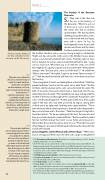
Fortress on the banks of
the Sea of Galilee in the territory of the Gerasenes
5:11 Why does Jesus allow the demons to enter the herd of swine? In Jewish tradition, swine were considered unclean animals, not to be eaten or touched, but among the Gerasenes— a Gentile community—this is probably simply a very valuable herd of livestock. One fact is clear: the power of the demons, and the greater power of Jesus, who masters them with a simple word.
5:18 The man who had been possessed by Legion wants to come along with Jesus when Jesus prepares to depart, but Jesus does not allow it. Instead, he tells the man to go home to his family and share what God has done for him. Not everyone is called to follow in the same way; but in one way or another all Christians are called to the same task: to tell what a merciful God has done for us.
88
MARK
The Healing of the Gerasene 5Demoniac.
1* a They came to the other side
of the sea, to the territory of the Gerasenes. 2When he got out of the boat, at once a man* from the tombs who had an unclean spirit met him. 3The man had been dwelling among the tombs, and no one could restrain him any longer, even with a chain. 4In fact, he had frequently been bound with shackles and chains, but the chains had been pulled apart by him and
the shackles smashed, and no one was strong enough to subdue him. 5Night and day among the tombs and on the hillsides he was always crying out and bruising himself with stones. 6Catching sight of Jesus from a distance, he ran up and prostrated himself before him, 7crying out in a loud voice, “What have you to do with me,* Jesus, Son of the Most High God? I adjure you by God, do not torment me!” 8(He had been saying to him, “Unclean spirit, come out of the man!”) 9* He asked him, “What is your name?” He replied, “Legion is my name. There are many of us.”b 10And he pleaded earnestly with him not to drive them away from that territory.
11Now a large herd of swine* was feeding there on the hillside. 12And they pleaded with him, “Send us into the swine. Let us enter them.” 13And he let them, and the unclean spirits came out and entered the swine. The herd of about two thousand rushed down a steep bank into the sea, where they were drowned. 14The swineherds ran away and reported the incident in the town and throughout the countryside. And people came out to see what had happened. 15As they approached Jesus, they caught sight of the man who had been possessed by Legion, sitting there clothed and in his right mind. And they were seized with fear. 16Those who witnessed the incident explained to them what had happened to the possessed man and to the swine. 17Then they began to beg him to leave their district. 18As he was getting into the boat, the man who had been possessed pleaded to remain with him. 19But he would not permit him but told him instead, “Go home* to your family and announce to them all that the Lord in his pity has done for you.” 20Then the man went off and began to proclaim in the Decapolis what Jesus had done for him; and all were amazed.
Jairus’s Daughter and the Woman with a Hemorrhage.* 21When Jesus had crossed again [in the boat] to the other side, a large crowd gathered
* [5:1] The territory of the Gerasenes: the reference is to pagan territory; cf. Is 65:1. Another reading is “Gadarenes”; see note on Mt 8:28.
* [5:2–6] The man was an outcast from society, dominated by unclean spirits (Mk 5:8, 13), living among the tombs. The prostration before Jesus (Mk 5:6) indicates Jesus’ power over evil spirits. Aramaic had gained widespread use in the Near East by the time of Jesus, because it had been used as the common diplomatic language of the Persian Empire, which had controlled the area centuries earlier.
* [5:7] What have you to do with me?: cf. Mk 1:24 and see note on Jn 2:4.
* [5:9] Legion is my name: the demons were numerous and the condition of the possessed
man was extremely serious; cf. Mt 12:45.
* [5:11] Herd of swine: see note on Mt 8:30.
* [5:19] Go home: Jesus did not accept the man’s request to remain with him as a disciple
(Mk 5:18), yet invited him to announce to his own people what the Lord had done for him,
i.e., proclaim the gospel message to his pagan family; cf. Mk 1:14, 39; 3:14; 13:10.
* [5:21–43] The story of the raising to life of Jairus’s daughter is divided into two parts: Mk 5:21– 24; 5:35–43. Between these two separated parts the account of the cure of the hemorrhage


