


Page 101 - Demo
P. 101
MARK
around him, and he stayed close to the sea.c 22One of the synagogue
officials, named Jairus, came forward.d Seeing him he fell at his feet
23and pleaded earnestly with him, saying, “My daughter is at the point *
of death. Please, come lay your hands on her that she may get well and live.” 24He went off with him, and a large crowd followed him and pressed upon him.
25There was a woman afflicted with hemorrhages for twelve years. 26She had suffered greatly at the hands of many doctors and had spent all that she had. Yet she was not helped but only grew worse. 27She had heard about Jesus and came up behind him in the crowd and touched his cloak. 28* She said, “If I but touch his clothes, I shall be cured.” 29Immediately her flow of blood dried up. She felt in her body that she was healed of her affliction. 30Jesus, aware at once that power had gone out from him, turned around in the crowd and asked, “Who has touched my clothes?” 31But his disciples said to him, “You see how the crowd is pressing upon you, and yet you ask, ‘Who touched me?’” 32And he looked around to see who had done it. 33The woman, realizing what had happened to her, approached in fear and trembling. She
fell down before Jesus and told him the whole truth. 34He said to her, “Daughter, your faith has saved you. Go in peace and be cured of your affliction.”e
35* While he was still speaking, people
from the synagogue official’s house
arrived and said, “Your daughter has
died; why trouble the teacher any
longer?” 36Disregarding the message
that was reported, Jesus said to the
synagogue official, “Do not be afraid;
just have faith.” 37He did not allow
anyone to accompany him inside except
Peter, James, and John, the brother of
James. 38When they arrived at the house of the synagogue official, he caught sight of a commotion, people weeping and wailing loudly. 39* f So he went in and said to them, “Why this commotion and weeping? The child is not dead but asleep.” 40And they ridiculed him. Then he put them all out. He took along the child’s father and mother and those who were with him and entered the room where the child was. 41* He took the child by the hand and said to her, “Talitha koum,” which means, “Little girl, I say to you, arise!” 42The girl, a child of twelve, arose immediately and walked around. [At that] they were utterly astounded. 43He gave strict orders that no one should know this and said that she should be given something to eat.
5:21
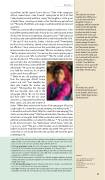
Two miracles are woven together here. While Jesus
is on his way to heal the daughter of Jairus, a synagogue o cial, a woman comes to him through the crowd and surreptitiously touches him that she may
be healed. The stories are connected: we are told that the woman has su ered
a hemorrhage for twelve years; the girl is twelve years old. The woman reaches
out to touch Jesus’ garment and is healed; Jesus reaches out to touch the child, and she is restored to life. In both miracles, the emphasis is
on faith: “Your faith has saved you,” Jesus says to the woman in the crowd. “Just have faith,” he tells Jairus.
5:41
The words Jesus spoke
to the little girl are quoted in the Aramaic which Jesus spoke: Talitha koum means “Little girl, arise.”
Chapter 5
a. [5:1–20] Mt 8:28–34; Lk 8:26–39. b. [5:9] Mt 12:45; Lk 8:2; 11:26.
c. [5:21] 2:13.
d. [5:22–43] Mt 9:18–26; Lk 8:41–56. e. [5:34] Lk 7:30.
f. [5:39–40] Acts 9:40.
89
victim (Mk 5:25–34) is interposed. This technique of intercalating or sandwiching one story within another occurs several times in Mk 3:19b–21; 3:22–30; 3:31–35; 6:6b–13; 6:14–29; 6:30; 11:12–14; 11:15–19; 11:20–25; 14:53; 14:54; 14:55–65; 14:66–73.
* [5:23] Lay your hands on her: this act for the purpose of healing is frequent in Mk 6:5; 7:32–35; 8:23–25; 16:18 and is also found in Mt 9:18; Lk 4:40; 13:13; Acts 9:17; 28:8.
* [5:28] Both in the case of Jairus and his daughter (Mk 5:23) and in the case of the hemorrhage victim, the inner conviction that physical contact (Mk 5:30) accompanied by faith in Jesus’ saving power could e ect a cure was rewarded.
* [5:35] The faith of Jairus was put to a twofold test: (1) that his daughter might be cured and, now that she had died, (2) that she might be restored to life. His faith contrasts with the lack of faith of the crowd.
* [5:39] Not dead but asleep: the New Testament often refers to death as sleep (Mt 27:52; Jn 11:11; 1 Cor 15:6; 1 Thes 4:13–15); see note on Mt 9:24.
* [5:41] Arise: the Greek verb egeirein is the verb generally used to express resurrection from death (Mk 6:14, 16; Mt 11:5; Lk 7:14) and Jesus’ own resurrection (Mk 16:6; Mt 28:6; Lk 24:6).


