


Page 102 - Demo
P. 102
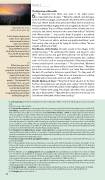
Nazareth, the town where Jesus grew up
In this chapter, the question of who Jesus is gets asked and answered in various ways. Jesus’ friends, King Herod, and the disciples all give di erent answers. Only after the resurrection of Jesus will the disciples fully understand who Jesus is.
6:2 When Jesus goes to his hometown of Nazareth, the people are “astonished” at his teaching, but they resist the power of his words. How could the son of ordinary people—“the carpenter, the son of Mary” (6:3)—do such extraordinary things? Their very familiarity with him becomes an obstacle to recognizing the power of God working through him.
MARK
6The Rejection at Nazareth.
1a He departed from there and came to his native place,*
accompanied by his disciples.
to teach in the synagogue, and many who heard him were astonished. They said, “Where did this man get all this? What kind of wisdom has been given him? What mighty deeds are wrought by his hands! 3b Is he not the carpenter,* the son of Mary, and the brother of James and Joses and Judas and Simon? And are not his sisters here with us?” And they took offense at him. 4* c Jesus said to them, “A prophet is not without honor except in his native place and among his own kin and in his own house.” 5So he was not able to perform any mighty deed there,* apart from curing a few sick people by laying his hands on them. 6He was amazed at their lack of faith.
The Mission of the Twelve. He went around to the villages in the vicinity teaching. 7d He summoned the Twelve* and began to send them out two by two and gave them authority over unclean spirits. 8* He instructed them to take nothing for the journey but a walking stick—no food, no sack, no money in their belts. 9They were, however, to wear sandals but not a second tunic. 10* He said to them, “Wherever you enter a house, stay there until you leave from there. 11Whatever place does not welcome you or listen to you, leave there and shake the dust off your feet in testimony against them.” 12So they went off and preached repentance. 13* They drove out many demons, and they anointed with oil many who were sicke and cured them.
Herod’s Opinion of Jesus.* 14King Herod* heard about it, for his fame had become widespread, and people were saying,f “John the Baptist has been raised from the dead; that is why mighty powers are at work in him.”g 15Others were saying, “He is Elijah”; still others, “He is a prophet like any of the prophets.”h 16But when Herod learned of it, he said, “It is John whom I beheaded. He has been raised up.”
2*
When the sabbath came he began
..90
* [6:1] His native place: the Greek word patris here refers to Nazareth (cf. Mk 1:9; Lk 4:16, 23–24) though it can also mean native land.
* [6:2–6] See note on Mt 13:54–58.
* [6:3] Is he not the carpenter?: no other gospel calls Jesus a carpenter. Some witnesses have “the carpenter’s son,” as in Mt 13:55.
Son of Mary: contrary to Jewish custom, which calls a man the son of his father, this expression may reflect Mark’s own faith that God is the Father of Jesus (Mk 1:1, 11; 8:38; 13:32; 14:36). The brother of James. . .Simon: in Semitic usage, the terms “brother,” “sister” are applied not only to children of the same parents, but to nephews, nieces, cousins, half-brothers, and half-sisters; cf. Gn 14:16; 29:15; Lv 10:4. While one cannot suppose that the meaning of a Greek word should be sought in the first place from Semitic usage, the Septuagint often translates the Hebrew ’āh by the Greek word adelphos, “brother,” as in the cited passages, a fact that may argue for a similar breadth of meaning in some New Testament passages. For instance, there is no doubt that in v 17, “brother” is used of Philip, who was actually the half-brother of Herod Antipas. On the other hand, Mark may have understood the terms literally; see also Mk 3:31–32; Mt 12:46; 13:55–56; Lk 8:19; Jn 7:3, 5. The question of meaning here would not have arisen but for the faith of the church in Mary’s perpetual virginity.
* [6:4] A prophet is not without honor except. . .in his own house: a saying that finds parallels in other literatures, especially Jewish and Greek, but without reference to a prophet. Comparing himself to previous Hebrew prophets whom the people rejected, Jesus intimates his own eventual rejection by the nation especially in view of the dishonor his own relatives had shown him (Mk 3:21) and now his townspeople as well.
* [6:5] He was not able to perform any mighty deed there: according to Mark, Jesus’ power could not take effect because of a person’s lack of faith.
* [6:7–13] The preparation for the mission of the Twelve is seen in the call (1) of the first disciples to be fishers of men (Mk 1:16–20), (2) then of the Twelve set apart to be with Jesus and to receive authority to preach and expel demons (Mk 3:13–19). Now they are given the specific mission to exercise that authority in word and power as representatives of Jesus during the time of their formation.
* [6:8–9] In Mark the use of a walking stick (Mk 6:8) and sandals (Mk 6:9) is permitted, but not in Mt 10:10 nor in Lk 10:4. Mark does not mention any prohibition to visit pagan territory and to enter Samaritan towns. These differences indicate a certain adaptation to conditions in and outside of Palestine and suggest in Mark’s account a later activity in the church. For the rest, Jesus required of his apostles a total dependence on God for food and shelter; cf. Mk 6:35–44; 8:1–9.
* [6:10–11] Remaining in the same house as a guest (Mk 6:10) rather than moving to another offering greater comfort avoided any impression of seeking advantage for oneself and prevented dishonor to one’s host. Shaking the dust off one’s feet served as testimony against those who rejected the call to repentance.
* [6:13] Anointed with oil. . .cured them: a common medicinal remedy, but seen here as a vehicle of divine power for healing.
* [6:14–16] The various opinions about Jesus anticipate the theme of his identity that reaches its climax in Mk 8:27–30.
* [6:14] King Herod: see note on Mt 14:1.


