


Page 5 - DWF London Blueprint for Growth
P. 5
Workplace and employment sentiment


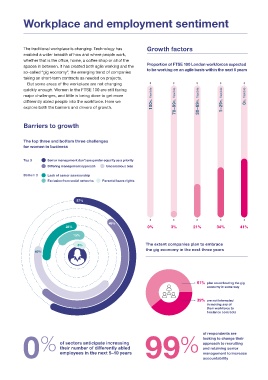
           The traditional workplace is changing. Technology has   Growth factors
           enabled a wider breadth of how and where people work,
           whether that is the office, home, a coffee shop or all of the
                                                                  Proportion of FTSE 100 London workforces expected
           spaces in between. It has created both agile working and the
                                                                  to be working on an agile basis within the next 5 years
           so-called “gig economy”, the emerging trend of companies
           taking on short-term contracts as needed on projects.
             But some areas of the workplace are not changing
           quickly enough. Women in the FTSE 100 are still facing
           major challenges, and little is being done to get more   flexible   flexible  flexible   flexible  flexible
           differently abled people into the workforce. Here we                                               0%
           explore both the barriers and drivers of growth.          100%      70–99%    30–69%     1–29%


           Barriers to growth


           The top three and bottom three challenges
           for women in business


           Top 3      Senior management don’t see gender equality as a priority
                      Differing management approach  Unconscious bias
           Bottom 3   Lack of senior sponsorship
                      Exclusion from social networks  Parental leave rights


                                   57%


                                                 49%
                              23%                                  0%        3%        21%       34%        41%
                                  15%

                                    8%                            The extent companies plan to embrace
                                                                  the gig economy in the next three years
                 40%


                                                                                         61% plan on embracing the gig
                                                                                             economy in some way


                                                                                         39% are not interested
                                                                                             in moving any of
                                                                                             their workforce to
                                                                                             freelance contracts


                                                                                           of respondents are
                                                                                           looking to change their
                            of sectors anticipate increasing                               approach to recruiting
                            their number of differently abled                              and retaining senior
                            employees in the next 5–10 years                               management to increase
                                                                                           accountability

