


Page 132 - SAPEM-Chapter-10-2nd-edition-2014
P. 132
South African Pavement Engineering Manual
                                              Chapter 10:  Pavement Design


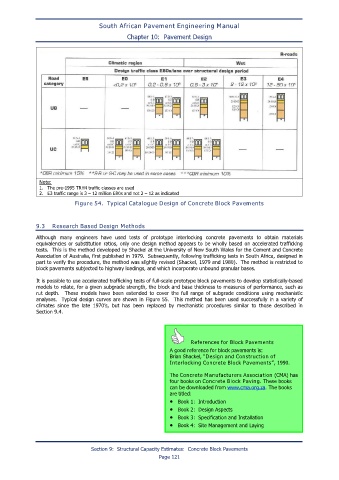
               Note:
               1.  The pre-1995 TRH4 traffic classes are used
               2.  E3 traffic range is 3 – 12 million E80s and not 2 – 12 as indicated
                           Figure 54.  Typical Catalogue Design of Concrete Block Pavements


              9.3  Research Based Design Methods
              Although many engineers have used  tests of prototype interlocking concrete pavements to obtain materials
              equivalencies or substitution ratios, only one design method appears to be wholly based on accelerated trafficking
              tests.  This is the method developed by Shackel at the University of New South Wales for the Cement and Concrete
              Association of Australia, first published in 1979.  Subsequently, following trafficking tests in South Africa, designed in
              part to verify the procedure, the method was slightly revised (Shackel, 1979 and 1980).  The method is restricted to
              block pavements subjected to highway loadings, and which incorporate unbound granular bases.

              It is possible to use accelerated trafficking tests of full-scale prototype block pavements to develop statistically-based
              models to relate, for a given subgrade strength, the block and base thickness to measures of performance, such as
              rut  depth.    These  models  have  been  extended  to  cover  the  full  range  of  subgrade  conditions  using  mechanistic
              analyses.  Typical design curves are shown in Figure 55.  This method has been used successfully in a variety of
              climates  since  the  late  1970’s,  but  has  been  replaced  by  mechanistic  procedures  similar  to  those  described  in
              Section 9.4.


                                                                   References for Block Pavements
                                                             A good reference for block pavements is:
                                                             Brian Shackel, “Design and Construction of
                                                             Interlocking Concrete Block Pavements”, 1990.

                                                             The Concrete Manufacturers Association (CMA) has
                                                             four books on Concrete Block Paving. These books
                                                             can be downloaded from www.cma.org.za. The books
                                                             are titled:
                                                             •  Book 1:  Introduction
                                                             •  Book 2:  Design Aspects
                                                             •  Book 3:  Specification and Installation
                                                             •  Book 4:  Site Management and Laying


                                 Section 9:  Structural Capacity Estimates:  Concrete Block Pavements
                                                         Page 121

