


Page 26 - HaMizrachi Chanukah 5783 USA
P. 26
Netzach Yisrael, remaining active even after the Russian
             government forced the yeshiva to close in 1892. The next
             year, he attended a secret meeting of the Chovevei Tzion
             movement, led by the famed early Religious Zionist leader,
             Rav Shmuel Mohilever. Word soon reached Rav Mohilever
             about the brilliant young Nissenbaum, leading Rav Mohile-
             ver to offer him the opportunity to become the secretary of
             the new “Merkaz HaRuchani” movement, usually abbreviated
             as “Mizrachi”, the predecessor to the Mizrachi movement
             that would later be founded by Rav Yitzchak Ya’akov Reines
             in 1902. When Rav Nissenbaum arrived in Bialystok in 1894
             to assume the position, Rav Mohilever looked at the young
             man with penetrating eyes and quietly said, “So young!”
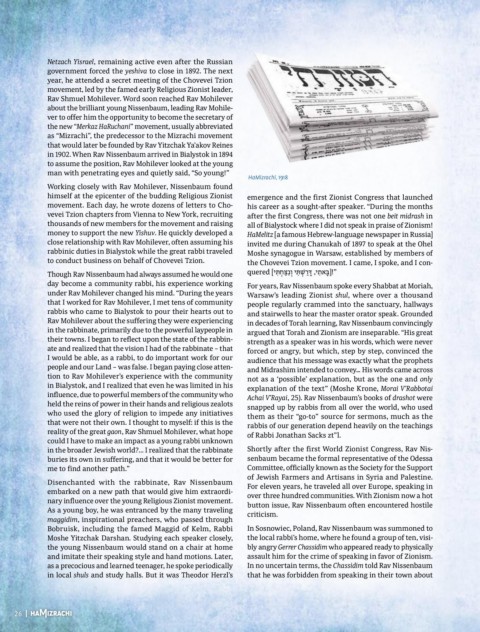
                                                              HaMizrachi, 1918
             Working closely with Rav Mohilever, Nissenbaum found
             himself at the epicenter of the budding Religious Zionist   emergence and the first Zionist Congress that launched
             movement. Each day, he wrote dozens of letters to Cho-  his career as a sought-after speaker. “During the months
             vevei Tzion chapters from Vienna to New York, recruiting   after the first Congress, there was not one beit midrash in
             thousands of new members for the movement and raising   all of Bialystock where I did not speak in praise of Zionism!
             money to support the new Yishuv. He quickly developed a   HaMelitz [a famous Hebrew-language newspaper in Russia]
             close relationship with Rav Mohilever, often assuming his   invited me during Chanukah of 1897 to speak at the Ohel
             rabbinic duties in Bialystok while the great rabbi traveled   Moshe synagogue in Warsaw, established by members of
             to conduct business on behalf of Chovevei Tzion.  the Chovevei Tzion movement. I came, I spoke, and I con-
             Though Rav Nissenbaum had always assumed he would one   quered [י ִּ ת ְח ַּצ ִנ ְו י ִּ ת ְ ׁש ַר ָ ּ ד ,י ִתא ָּ ב]!”
             day become a community rabbi, his experience working   For years, Rav Nissenbaum spoke every Shabbat at Moriah,
             under Rav Mohilever changed his mind. “During the years   Warsaw’s leading Zionist shul, where over a thousand
             that I worked for Rav Mohilever, I met tens of community   people regularly crammed into the sanctuary, hallways
             rabbis who came to Bialystok to pour their hearts out to   and stairwells to hear the master orator speak. Grounded
             Rav Mohilever about the suffering they were experiencing   in decades of Torah learning, Rav Nissenbaum convincingly
             in the rabbinate, primarily due to the powerful laypeople in   argued that Torah and Zionism are inseparable. “His great
             their towns. I began to reflect upon the state of the rabbin-  strength as a speaker was in his words, which were never
             ate and realized that the vision I had of the rabbinate – that   forced or angry, but which, step by step, convinced the
             I would be able, as a rabbi, to do important work for our   audience that his message was exactly what the prophets
             people and our Land – was false. I began paying close atten-  and Midrashim intended to convey… His words came across
             tion to Rav Mohilever’s experience with the community   not as a ‘possible’ explanation, but as the one and only
             in Bialystok, and I realized that even he was limited in his   explanation of the text” (Moshe Krone, Morai V’Rabbotai
             influence, due to powerful members of the community who   Achai V’Rayai, 25). Rav Nissenbaum’s books of drashot were
             held the reins of power in their hands and religious zealots   snapped up by rabbis from all over the world, who used
             who used the glory of religion to impede any initiatives   them as their “go-to” source for sermons, much as the
             that were not their own. I thought to myself: if this is the   rabbis of our generation depend heavily on the teachings
             reality of the great gaon, Rav Shmuel Mohilever, what hope   of Rabbi Jonathan Sacks zt”l.
             could I have to make an impact as a young rabbi unknown
             in the broader Jewish world?... I realized that the rabbinate   Shortly after the first World Zionist Congress, Rav Nis-
             buries its own in suffering, and that it would be better for   senbaum became the formal representative of the Odessa
             me to find another path.”                        Committee, officially known as the Society for the Support
                                                              of Jewish Farmers and Artisans in Syria and Palestine.
             Disenchanted with the  rabbinate,  Rav Nissenbaum   For eleven years, he traveled all over Europe, speaking in
             embarked on a new path that would give him extraordi-  over three hundred communities. With Zionism now a hot
             nary influence over the young Religious Zionist movement.   button issue, Rav Nissenbaum often encountered hostile
             As a young boy, he was entranced by the many traveling   criticism.
             maggidim, inspirational preachers, who passed through
             Bobruisk, including the famed Maggid of Kelm, Rabbi   In Sosnowiec, Poland, Rav Nissenbaum was summoned to
             Moshe Yitzchak Darshan. Studying each speaker closely,   the local rabbi’s home, where he found a group of ten, visi-
             the young Nissenbaum would stand on a chair at home   bly angry Gerrer Chassidim who appeared ready to physically
             and imitate their speaking style and hand motions. Later,   assault him for the crime of speaking in favor of Zionism.
             as a precocious and learned teenager, he spoke periodically   In no uncertain terms, the Chassidim told Rav Nissenbaum
             in local shuls and study halls. But it was Theodor Herzl’s   that he was forbidden from speaking in their town about


    26  |

