


Page 29 - HaMizrachi Chanukah 5783 USA
P. 29
lemonade with ice. Surprised, Rav Nissenbaum asked his   Rav Nissenbaum rebuked the religious Jews of Petach Tikva
             host where the ice had come from. “Do you have a machine   for not embracing the workers and hiring Arabs at cheaper
             that makes ice?” Laughing, his host explained that the “ice”   prices, passionately quoting the Talmud Yerushalmi’s pro-
             was actually packed snow from Mount Hermon, which an   hibition: “Do not hire gentile workers [when Jewish labor is
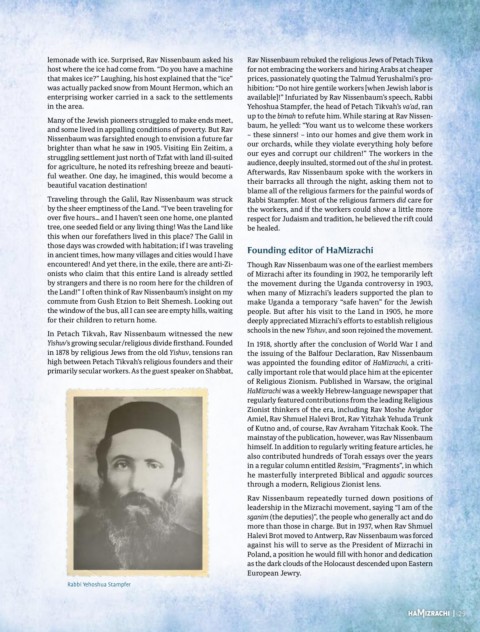
             enterprising worker carried in a sack to the settlements   available]!” Infuriated by Rav Nissenbaum’s speech, Rabbi
             in the area.                                     Yehoshua Stampfer, the head of Petach Tikvah’s va’ad, ran
                                                              up to the bimah to refute him. While staring at Rav Nissen-
             Many of the Jewish pioneers struggled to make ends meet,
             and some lived in appalling conditions of poverty. But Rav   baum, he yelled: “You want us to welcome these workers
             Nissenbaum was farsighted enough to envision a future far   – these sinners! – into our homes and give them work in
             brighter than what he saw in 1905. Visiting Ein Zeitim, a   our orchards, while they violate everything holy before
             struggling settlement just north of Tzfat with land ill-suited   our eyes and corrupt our children!” The workers in the
             for agriculture, he noted its refreshing breeze and beauti-  audience, deeply insulted, stormed out of the shul in protest.
             ful weather. One day, he imagined, this would become a   Afterwards, Rav Nissenbaum spoke with the workers in
             beautiful vacation destination!                  their barracks all through the night, asking them not to
                                                              blame all of the religious farmers for the painful words of
             Traveling through the Galil, Rav Nissenbaum was struck   Rabbi Stampfer. Most of the religious farmers did care for
             by the sheer emptiness of the Land. “I’ve been traveling for   the workers, and if the workers could show a little more
             over five hours… and I haven’t seen one home, one planted   respect for Judaism and tradition, he believed the rift could
             tree, one seeded field or any living thing! Was the Land like   be healed.
             this when our forefathers lived in this place? The Galil in
             those days was crowded with habitation; if I was traveling   Founding editor of HaMizrachi
             in ancient times, how many villages and cities would I have
             encountered! And yet there, in the exile, there are anti-Zi-  Though Rav Nissenbaum was one of the earliest members
             onists who claim that this entire Land is already settled   of Mizrachi after its founding in 1902, he temporarily left
             by strangers and there is no room here for the children of   the movement during the Uganda controversy in 1903,
             the Land!” I often think of Rav Nissenbaum’s insight on my   when many of Mizrachi’s leaders supported the plan to
             commute from Gush Etzion to Beit Shemesh. Looking out   make Uganda a temporary “safe haven” for the Jewish
             the window of the bus, all I can see are empty hills, waiting   people. But after his visit to the Land in 1905, he more
             for their children to return home.               deeply appreciated Mizrachi’s efforts to establish religious
                                                              schools in the new Yishuv, and soon rejoined the movement.
             In Petach Tikvah, Rav Nissenbaum witnessed the new
             Yishuv’s growing secular/religious divide firsthand. Founded   In 1918, shortly after the conclusion of World War I and
             in 1878 by religious Jews from the old Yishuv, tensions ran   the issuing of the Balfour Declaration, Rav Nissenbaum
             high between Petach Tikvah’s religious founders and their   was appointed the founding editor of HaMizrachi, a criti-
             primarily secular workers. As the guest speaker on Shabbat,   cally important role that would place him at the epicenter
                                                              of Religious Zionism. Published in Warsaw, the original
                                                              HaMizrachi was a weekly Hebrew-language newspaper that
                                                              regularly featured contributions from the leading Religious
                                                              Zionist thinkers of the era, including Rav Moshe Avigdor
                                                              Amiel, Rav Shmuel Halevi Brot, Rav Yitzhak Yehuda Trunk
                                                              of Kutno and, of course, Rav Avraham Yitzchak Kook. The
                                                              mainstay of the publication, however, was Rav Nissenbaum
                                                              himself. In addition to regularly writing feature articles, he
                                                              also contributed hundreds of Torah essays over the years
                                                              in a regular column entitled Resisim, “Fragments”, in which
                                                              he masterfully interpreted Biblical and aggadic sources
                                                              through a modern, Religious Zionist lens.
                                                              Rav Nissenbaum repeatedly turned down positions of
                                                              leadership in the Mizrachi movement, saying “I am of the
                                                              sganim (the deputies)”, the people who generally act and do
                                                              more than those in charge. But in 1937, when Rav Shmuel
                                                              Halevi Brot moved to Antwerp, Rav Nissenbaum was forced
                                                              against his will to serve as the President of Mizrachi in
                                                              Poland, a position he would fill with honor and dedication
                                                              as the dark clouds of the Holocaust descended upon Eastern
                                                              European Jewry.
                  Rabbi Yehoshua Stampfer


                                                                                                                  |  29

