


Page 47 - HaMizrachi Chanukah 5783 USA
P. 47
Because, says the Talmud, you diminish the first candle.   had detonated his belt on a bus in Tel Aviv, and that one of our
              Inevitably you spill some of the wax or the oil. And Rav   members, Yoni Jesner hy”d, was on that bus. Yoni was rushed
              says: Don’t do anything that would diminish the light of   to hospital, and we quickly arranged an evening of prayer at
              the first.                                      our London headquarters. Yoni was still in intensive care, but
                                                              we knew there was no hope.
              But Shmuel disagrees, and the law follows Shmuel. Why?
                                                              As news spread of the gathering, Rabbi Sacks called me to say
              The best way of answering that is to think of two Jews:   he would like to be with us. He didn’t wait to be asked; he knew
              both religious, both committed, both living Jewish lives.
              One says: I must not get involved with Jews who are less   this is where he was needed. He addressed the packed room,
                                                              giving strength to Yoni’s many friends and his wider Bnei Akiva
              religious than me, because if I do, my own standards will
              fall. I’ll keep less. My light will be diminished. That’s the   family. It was a challenging moment for Bnei Akiva, and in
                                                              Rabbi Sacks we had a leader we so desperately needed to light
              view of Rav.
                                                              the way. His presence with us that night was a tremendous
              The other says: No. When I use the flame of my faith to   source of comfort and hope.
              light a candle in someone else’s life, my Jewishness is not
              diminished, it grows, because there is now more Jewish   Whenever Rabbi Sacks visited Israel, I would invite him to
                                                              speak to Bnei Akiva students on their gap year. He never once
              light in the world. When it comes to spiritual goods as
              opposed to material goods, the more I share, the more I   refused. On one occasion, when he had finished speaking, he
                                                              sat down, turned to me, and asked, “Was that okay?” This was
              have. If I share my knowledge, or faith, or love with others,   one of the Jewish world’s greatest orators, the Chief Rabbi of the
              I won’t have less; I may even have more. That’s the view of
              Shmuel, and that is how the law was eventually decided.  United Kingdom and the Commonwealth, and he was asking
                                                              me if he spoke well! This spoke volumes about his humility. He
          This is the message of hope. The hope that if we work together –   was a foremost leader of the Jewish community, but recognized
          rather than in isolation – and share our Judaism, we can make   that I was the leader of this group, and so my opinion mattered
          things better. We can take the flame of our faith and help set   to him. In three short words, I learned from him that it is not
          other souls on fire.                                the honors we receive that matter, but the honor we give.
          In To Heal a Fractured World, Rabbi Sacks describes the difference   Rabbi Sacks is missed every day. May his voice continue to
          between optimism and hope: “Optimism and hope are not the   illuminate the world with light and hope, and may his memory
          same. Optimism is the belief that the world is changing for   and legacy be an everlasting blessing.
          the better; hope is the belief that, together, we can make the
          world better. Optimism is a passive virtue, hope an active one.
          It needs no courage to be an optimist, but it takes a great deal
          of courage to hope. The Hebrew Bible is not an optimistic book.
          It is, however, one of the great literatures of hope.”
          If we work together, we can make things better. That, says
          Rabbi Sacks, is hope. If you lift someone else, you yourself
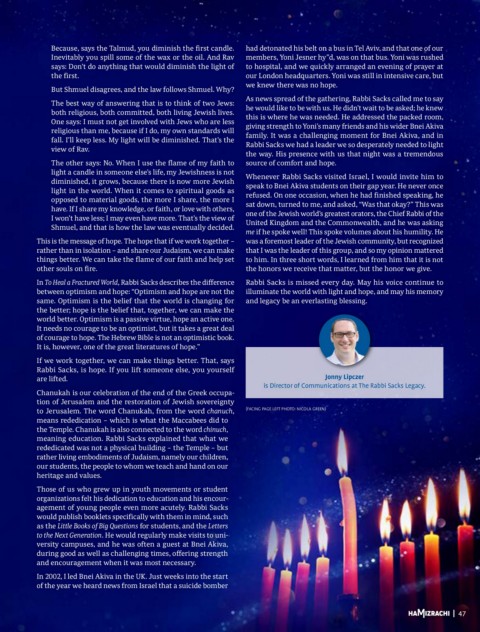
          are lifted.                                                             Jonny Lipczer
                                                                  is Director of Communications at The Rabbi Sacks Legacy.
          Chanukah is our celebration of the end of the Greek occupa-
          tion of Jerusalem and the restoration of Jewish sovereignty
          to Jerusalem. The word Chanukah, from the word chanuch,   (FACING PAGE LEFT PHOTO: NICOLA GREEN)
          means rededication – which is what the Maccabees did to
          the Temple. Chanukah is also connected to the word chinuch,
          meaning education. Rabbi Sacks explained that what we
          rededicated was not a physical building – the Temple – but
          rather living embodiments of Judaism, namely our children,
          our students, the people to whom we teach and hand on our
          heritage and values.
          Those of us who grew up in youth movements or student
          organizations felt his dedication to education and his encour-
          agement of young people even more acutely. Rabbi Sacks
          would publish booklets specifically with them in mind, such
          as the Little Books of Big Questions for students, and the Letters
          to the Next Generation. He would regularly make visits to uni-
          versity campuses, and he was often a guest at Bnei Akiva,
          during good as well as challenging times, offering strength
          and encouragement when it was most necessary.
          In 2002, I led Bnei Akiva in the UK. Just weeks into the start
          of the year we heard news from Israel that a suicide bomber


                                                                                                                  |  47

