


Page 26 - Advertising Annual 55
P. 26
                DESIGN DETAILS
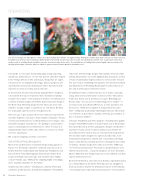
   The art and design duo Pinar&Viola creates decorative design that reflects our digital reality. During the climate talks that took place in Paris last year, Pinar&Viola created a video installation, Mother Earth in Paris (left), for ArtCOP21, the art event surrounding the summit. The creative pair envisioned mother earth as a talking flower (middle). MTV also aired an excerpt of the video. The installation—including fabric prints (right)—was a preview of its Healing Prints Image Collection, which is slated to appear at Paris Fashion Week in September 2016.
“I would like to see people start playing again, being surprising, mysterious, with bold uses of color. Not just the same five elegant fonts—things with more bite and impact, things that are edgier.
I would love to see magazines like Vogue, which is gorgeous and experimental in print, have that impact online. But still, its web experience is very secondary and second rate.”
As the Internet becomes the primary playing field for designers,
I also lament the lack of ornament online. Not that everything should be decorative—some brands are meant to be minimal, and countless minimal designs are brilliant. But if interactive design is the Noah’s Ark delivering design into the future, we need each animal to sustain a viable ecosystem in our new world. We have too many plain squirrels and not enough peacocks.
This isn’t just a “gee, wouldn’t it be nice” wish list—experiments and risks might be necessary to keep designers employed. “People need to push themselves to do things that are more unique,” says interactive designer Sean Klassen. “It’s getting to a point where anyone could design most of what we see online. If everyone is making designs that look the same, there’s no reason our clients can’t use Squarespace.
“We could be designing ourselves out of jobs.”
Swashbuckling designers
Most of the excitement in ornamental design today appears in Europe. For the design equivalent of vibrant peacocks, look no further than the creative Dutch and Turkish duo Pınar&Viola, now based in Paris. Pınar Demirdağ and Viola Renate started their studio in Holland seven years ago and call their style “digital couture.” Renate says, “Without the crippling weight of nostalgia, we’re creating ornaments for the future.”
Inspired by online culture—including GIFs, amateur Photoshop aesthetics, profile pictures and website wallpapers—Pınar&Viola
rejects the clichéd vintage designs that replicate Victorian styles. Instead, they embrace our recent digital history and express a vision of how ornamentation might continue to evolve and be relevant. The duo releases everything from patterns for Paris Fashion Week and illustrations for Bloomberg Businessweek to videos that air on MTV and anarchist queer interactive novels.
Pınar&Viola believes ornament holds a lot of power, especially today, when we face information overdose online. “Decoration makes you dream, and it provides an escape,” Demirdağ says. Renate adds, “You can use it to make things more sellable—or to reveal social and cultural differences, to raise questions and discussions. I think we’re capable of doing both at the same time—selling and questioning.” Demirdağ interjects, “Decoration is a reflection of diversity in sexuality, ethnicity, personalities. It has so many possibilities.”
In Europe, Pınar&Viola and other designers—including Swiss graphic designer Felix Pfäffli, founder of Studio Feixen, and in Amsterdam the studio Niessen & de Vries and graphic designer Job Wouters— say they’ve found a more receptive audience and clientele for decorative work for various reasons: more government grants for the arts that enable designers to explore and take risks, more independent design firms, and the lack of a puritanical heritage that, in early America, shamed women for wearing the decoration of makeup. “Graphic design here is like an art form,” Pfäffli says. “So it’s like a luxury product. This leads to design that goes a bit further beyond trends. ... European designers are more like public figures. With that, the designers get more self-confident, and they express themselves more.”
Back in North America, near Vancouver, Bantjes, regarded by many as a seminal figure in decorative lettering, says she struggles to drum up business despite her widespread respect in the industry. “I’ve actually had a really bad year this past year—I’ve had almost
26 Illustration Annual 2016


