Page 74 - 2021 April 1, ART OF THE ISLAMIC AND Indian Worlds Including Oriental Rugs, Christie's London
P. 74
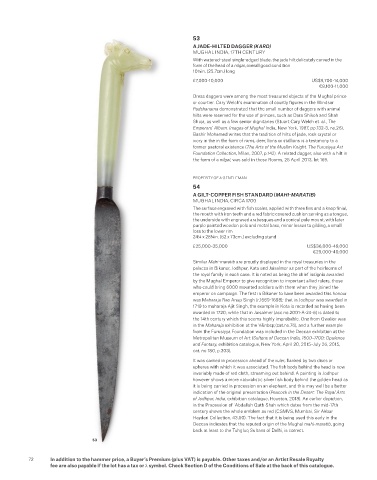
53
                                                              A JADE-HILTED DAGGER (KARD)
                                                              MUGHAL INDIA, 17TH CENTURY
                                                              With watered-steel single-edged blade, the jade hilt delicately carved in the
                                                              form of the head of a nilgai, overall good condition
                                                              10¿in. (25.7cm.) long
                                                              £7,000-10,000                        US$9,700-14,000
                                                                                                      €8,100-11,000
                                                              Dress daggers were among the most treasured objects of the Mughal prince
                                                              or courtier. Cary Welch’s examination of courtly figures in the Windsor
                                                              Padshanama demonstrated that the small number of daggers with animal
                                                              hilts were reserved for the use of princes, such as Dara Shikoh and Shah
                                                              Shuja, as well as a few senior dignitaries (Stuart Cary Welch et. al., The
                                                              Emperors’ Album. Images of Mughal India, New York, 1987, pp.132-3, no.26).
                                                              Bashir Mohamed writes that the tradition of hilts of jade, rock crystal or
                                                              ivory in the in the form of rams, deer, lions or stallions is a testimony to a
                                                              former pastoral existence (The Arts of the Muslim Knight. The Furusiyya Art
                                                              Foundation Collection, Milan, 2007, p.142). A related dagger, also with a hilt in
                                                              the form of a nilgai, was sold in these Rooms, 25 April 2013, lot 169.


                                                              PROPERTY OF A GENTLEMAN
                                                              54
                                                              A GILT-COPPER FISH STANDARD (MAHI-MARATIB)
                                                              MUGHAL INDIA, CIRCA 1700
                                                              The surface engraved with fish scales, applied with three fins and a knop finial,
                                                              the mouth with iron teeth and a red fabric covered cushion serving as a tongue,
                                                              the underside with engraved arabesques and a conical pole mount, with later
                                                              purple painted wooden pole and metal base, minor losses to gilding, a small
                                                              loss to the lower rim
                                                              24º x 28æin. (62 x 73cm.) excluding stand
                                                              £25,000-35,000                      US$36,000-49,000
                                                                                                    €29,000-40,000
                                                              Similar Mahi-maratib are proudly displayed in the royal treasuries in the
                                                              palaces in Bikaner, Jodhpur, Kota and Jaisalmer as part of the heirlooms of
                                                              the royal family in each case. It is noted as being the chief insignia awarded
                                                              by the Mughal Emperor to give recognition to important allied rulers, those
                                                              who could bring 6000 mounted soldiers with them when they joined the
                                                              emperor on campaign. The first in Bikaner to have been awarded this honour
                                                              was Maharaja Rao Anup Singh (r.1669-1698); that in Jodhpur was awarded in
                                                              1719 to maharaja Ajit Singh, the example in Kota is recorded as having been
                                                              awarded in 1720; while that in Jaisalmer (acc.no.2001-A-24-6) is dated to
                                                              the 14th century which this seems highly improbable. One from Gwalior was
                                                              in the Maharaja exhibition at the V (cat.no.76), and a further example
                                                              from the Furusiyya Foundation was included in the Deccan exhibition at the
                                                              Metropolitan Museum of Art (Sultans of Deccan India, 1500–1700: Opulence
                                                              and Fantasy, exhibition catalogue, New York, April 20, 2015–July 26, 2015,
                                                              cat. no 180, p.303).
                                                              It was carried in procession ahead of the ruler, flanked by two discs or
                                                              spheres with which it was associated. The fish body behind the head is now
                                                              invariably made of red cloth, streaming out behind. A painting in Jodhpur
                                                              however shows a more naturalistic silver fish body behind the golden head as
                                                              it is being carried in procession on an elephant, and this may well be a better
                                                              indication of the original presentation (Peacock in the Desert: The Royal Arts
                                                              of Jodhpur, India, exhibition catalogue, Houston, 2018). An earlier depiction,
                                                              in the Procession of `Abdallah Qutb Shah which dates from the mid-17th
                                                              century shows the whole emblem as red (CSMVS, Mumbai, Sir Akbar
                                                              Haydari Collection, 43.50). The fact that it is being used this early in the
                                                              Deccan indicates that the reputed origin of the Mughal mahi-maratib, going
                                                              back at least to the Tuhgluq Sultans of Delhi, is correct.
                              53


                            h
                             e
                           t
                         t
                          o
                                 m
                                   e
                                m
                              h
                               a
                    d
                     d
                   a
          72     I In addition to the hammer price, a Buyer’s Premium (plus VAT) is payable. Other taxes and/or an Artist Resale Royalty
                 n
                       o
                        n
                       i
                     i
                      t
                                         a
                                       e
                                    p
                                        ,
                                     r
                                      i
                                          B
                                            y
                                   r
                                           u
                                      c
                        s
                        o
                                       a
                       l
                                          t
                                           a
                 fee are also payable if the lot has a tax or λ symbol. Check Section D of the Conditions of Sale at the back of this catalogue.
                                        s
                      a
                                         a
                                i
                                f
                               e
                                    o
                                  h
                                   e
                                    l
                                 t
                                      h
                            y
                          p
                           a
                             b
                              l
                            a
                                     t
   69   70   71   72   73   74   75   76   77   78   79