


Page 77 - 2021 April 1, ART OF THE ISLAMIC AND Indian Worlds Including Oriental Rugs, Christie's London
P. 77
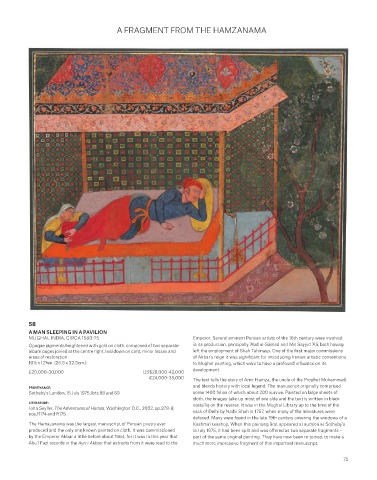
A FRAGMENT FROM THE HAMZANAMA


          58
          A MAN SLEEPING IN A PAVILION
          MUGHAL INDIA, CIRCA 1560-75                         Emperor. Several eminent Persian artists of the 16th century were involved
          Opaque pigments heightened with gold on cloth, composed of two separate   in its production, principally 'Abd al-Samad and Mir Sayyid 'Ali, both having
          album pages joined at the centre right, laid down on card, minor losses and   left the employment of Shah Tahmasp. One of the first major commissions
          areas of restoration                                of Akbar's reign it was significant for introducing Iranian artistic conventions
          10Ω x 12æin. (26.5 x 32.3cm.)                       to Mughal painting, which were to have a profound influence on its
                                                              development.
          £20,000-30,000                      US$28,000-42,000
                                                €24,000-35,000  The text tells the story of Amir Hamza, the uncle of the Prophet Muhammad,
                                                              and blends history with local legend. The manuscript originally comprised
          PROVENANCE:
          Sotheby's London, 15 July 1975, lots 88 and 89      some 1400 folios of which about 200 survive. Painted on large sheets of
                                                              cloth, the images take up most of one side and the text is written in black
          LITERATURE:                                         nasta'liq on the reverse. It was in the Mughal Library up to the time of the
          John Seyller, The Adventures of Hamza, Washington D.C., 2002, pp.278-9,
          nos.R174 and R175.                                  sack of Delhi by Nadir Shah in 1757, when many of the miniatures were
                                                              defaced. Many were found in the late 19th century covering the windows of a
          The Hamazanama was the largest manuscript of Persian poetry ever   Kashmiri teashop. When this painting first appeared at auction at Sotheby’s
          produced and the only one known painted on cloth. It was commissioned   in July 1975, it had been split and was offered as two separate fragments –
          by the Emperor Akbar a little before about 1564, for it was in this year that   part of the same original painting. They have now been re-joined, to make a
          Abu'l Fazl records in the Ayn-i Akbari that extracts from it were read to the   much more impressive fragment of this important manuscript.

                                                                                                             75

