


Page 155 - 'Blast_Into_Math
P. 155
Blast into Math! Analatic nummer theora: ants, ghosts and giants
∞ to converge. By the definition, for
Proof: First, let’s think about what it means for the sequence {x n } n=1
any ghost number > 0, there exists a giant number N ∈ N such that for all n ∈ N with n> N ,
|x n − X| <.
But, what does this mean? It means that the distance between x n and X on the number line is less than
. Now, let’s think about x n + s . Where is x n + s on the number line? It is x n moved either to the
right (if s is positive) or to the left (if s is negative) by a distance of s . Where is X + s on the number
line? It is X moved either to the right (if s is positive) or to the left (if s is negative) by a distance of s .
So, if x and X are close, then x + s and X + s are also close. More precisely, if the distance between x n
n n
and X is less than , then the distance between x n + s and X + s is less than epsilon. Why? Because
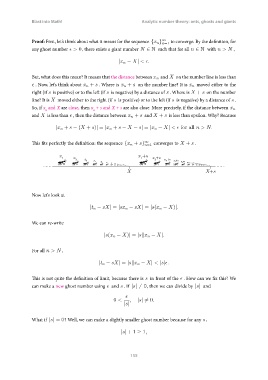
|x n + s − (X + s)| = |x n + s − X − s| = |x n − X| < forall n> N.
∞ converges to X + s .
This fits perfectly the definition: the sequence {x n + s} n=1
? ? LX
d ? d ? LX
1 ? 1 ? LX
n ? ; n ? ; LX
? x ? x LX
? E ? E LX ? LX
? ? M LX
? M ? ? d( ? LX
? dd ? d1 ? dn ? d( LX ? dd LX ? d1 LX ? dn LX ? d; LX ? dx LX ? dE LX ? d LX ? dM LX ? d LX ? 1( LX ? 1d LX ? 11 LX ? 1n LX
? d; ? dx ? dE ? d ? dM ? d ? 11 ? 1d ? 1( ? 1n
LX
Now let’s look at
|t n − sX| = |sx n − sX| = |s(x n − X)|.
We can re-write
|s(x n − X)| = |s||x n − X|.
For all n> N ,
|t n − sX| = |s||x n − X| < |s|.
This is not quite the definition of limit, because there is s in front of the . How can we fix this? We
can make a new ghost number using and s . If |s|=0, then we can divide by |s| and
0 < , |s|=0.
|s|
What if |s| =0? Well, we can make a slightly smaller ghost number because for any s ,
|s| +1 ≥ 1,
155

