


Page 164 - 'Blast_Into_Math
P. 164
Blast into Math! Analatic nummer theora: ants, ghosts and giants
The set R is just the set Q together with all the missing least upper bounds, and the remaining
assumptions guarantee that addition, multiplication, subtraction and division work the same way in R
as they do in Q . The fact that this set is unique is proven in [Ru].
Although we have only included the missing least upper bounds in property 2 above, this actually takes
care of the missing greatest lower bounds too.
To prove this we will use the following proposition about mirror-image sets.
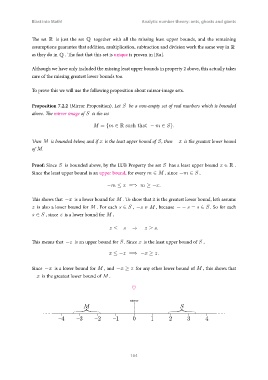
Proposition 7.2.2 (Mirror Proposition). Let S be a non-empty set of real numbers which is bounded
above. The mirror image of S is the set
M = {m ∈ R such that − m ∈ S}.
Then M is bounded below, and if x is the least upper bound of S, then −x is the greatest lower bound
of M.
Proof: Since S is bounded above, by the LUB Property the set S has a least upper bound x ∈ R .
Since the least upper bound is an upper bound, for every m ∈ M , since −m ∈ S ,
−m ≤ x =⇒ m ≥−x.
This shows that −x is a lower bound for M . To show that it is the greatest lower bound, let’s assume
z is also a lower bound for M . For each s ∈ S , −s ∈ M , because −− s = s ∈ S . So for each
s ∈ S , since z is a lower bound for M ,
z ≤−s =⇒−z ≥ s.
This means that −z is an upper bound for S . Since x is the least upper bound of S ,
x ≤−z =⇒−x ≥ z.
Since −x is a lower bound for M , and −x ≥ z for any other lower bound of M , this shows that
−x is the greatest lower bound of M .
♥
8$B
- C
u; un u1 ( ud d 1 n ;
164

