


Page 25 - Australian Photography - September 2017
P. 25
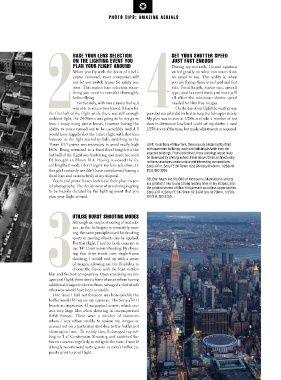
PHOTO TIPS: AMA Z ING AER IALS


                      2          BASE YOUR LENS SELECTION         4          SET YOUR SHUTTER SPEED


                                 ON THE LIGHTING EVENT YOU
                                                                             JUST FAST ENOUGH
                                 PLAN YOUR FLIGHT AROUND
                                                                             During my research, I found opinions
                                                                             varied greatly on what minimum shut-
                                 When you fly with the doors of a heli-
                                 copter removed, most companies will
                                                                             ter speed to use. The reality is, when
                                 not let you switch lenses for safety rea-
                                                                             you are flying, there is no hard and fast
                                                                             rule. Focal length, sensor size, aircraft
                                 sons. This makes lens selection some-
                                                                             type, weather conditions and more will
                                 thing you need to consider thoroughly
                                                                             all affect the minimum shutter speed
                                 before flying.
                                   Fortunately, with two camera bodie, I
                                                                             needed for blur free images.
                                 was able to access two lensed. I knew for
                                                                               On the day of our flight the weather was
                       the first half of the flight while there was still enough   poor, but our pilot did his best to keep the helicopter steady.
                       ambient light, the 24-70mm was going to be my go-to   My plan was to start at 1/250s and take a number of test
                       lens. I enjoy using prime lenses, however having the   shots to determine how low I could set my shutter. I used
                       ability to zoom turned out to be incredibly useful. I   1/250s most of the time, but made adjustments as required.
                       would have happily shot the entire flight with that lens
                       however as the light started to fade, switching to the
                       35mm f/1.4 prime was necessary to avoid really high   LEFT: In sections of New York, there are city blocks tightly filled
                       ISOs. Being restricted to a fixed focal length for the   with apartment buildings, each one indistinguishable from the
                       last half of the flight was frustrating and made me wish   adjacent buildings. From street level, these buildings would likely
                                                                  be dismissed by photographers. From above, these architecturally
                       I’d brought an 85mm f/1.4. Having reviewed the fo-
                                                                  uniform structures create unique and interesting compositions.
                       cal lengths I used, I don’t regret my lens selection, al-  Sony a7R II, Sony FE 24-70mm f/2.8 GM lens @ 43mm, 1/250s @
                       though I certainly wouldn’t have complained having a   f/2.8, ISO 3200.
                       third lens and camera body at my disposal.
                                                                  BELOW: Much like the CBD of Melbourne, Manhattan’s streets
                        Zoom and prime lenses both have their place in aer-
                                                                  are gridded. I like to use strong leading lines in my images, and
                       ial photography. The decision on what to bring is going
                                                                  the gridded streets of New York present countless opportunities.
                       to be heavily dictated by the lighting event that you   Sony a7R II, Sony FE 24-70mm f/2.8 GM lens @ 70mm, 1/250s
                       plan your flight around.
                                                                  @ f/2.8, ISO 3200.
                      3          UTILISE BURST SHOOTING MODES
                                 Although we may be shooting a fixed sub-
                                 ject, as the helicopter is constantly mov-
                                 ing, the same principles used for shooting
                                 sports or moving objects can be applied.
                                 For this flight, I had set both cameras to
                                 use ‘Hi’ Continuous Shooting. By choos-
                                 ing this drive mode over single-frame
                                 shooting, I would end up with a series
                                 of images, allowing me the flexibility to
                                 choose the frame with the least motion
                       blur and the best composition. Upon reviewing my im-
                       ages post flight, there were a few instances where having
                       additional images to choose from, salvaged a shot which
                       otherwise would have been unusable.
                        One issue I had not foreseen was how quickly the
                       buffer would fill up on my cameras. The Sony a7R II
                       boasts an impressive 42-megapixel sensor, which cre-
                       ates very large files when shooting in uncompressed
                       RAW format. There were a number of instances
                       where I was either unable to review my images or
                       missed out on a particular shot due to the buffer not
                       clearing in time. To rectify this, I changed my set-
                       ting to ‘Lo’ Continuous Shooting and switched be-
                       tween cameras regularly to mitigate the issue. I would
                       strongly recommend testing your camera’s buffer ca-
                       pacity prior to your flight.

