


Page 26 - Australian Photography - September 2017
P. 26
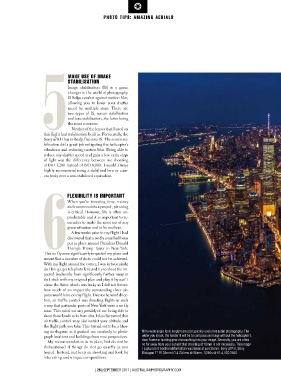
PHOTO TIPS: AMA Z ING AER IALS


                               MAKE USE OF IMAGE
                               STABILISATION
                               Image stabilisation (IS) is a game
                               changer in the world of photography.
                               IS helps combat against motion blur,
                               allowing you to lower your shutter
                               speed by multiple stops. There are
                               two types of IS, sensor stabilisation
                               and lens stabilisation, the latter being
                               the most common.
                    5 Neither of the lenses that I used on
                     this flight had stabilisation built in. Fortunately, the
                     Sony a7R II has in-body, five-axis IS. The sensor sta-
                     bilisation did a great job mitigating the helicopter’s
                     vibrations and reducing motion blur. Being able to
                     reduce my shutter speed and gain a few extra stops
                     of light was the difference between me shooting
                     at ISO 3,200 instead of ISO 8,000. I would always
                     highly recommend using a stabilised lens or cam-
                     era body over a non-stabilised equivalent.


                               FLEXIBILITY IS IMPORTANT
                               When you’re investing time, money
                               and resources into a project, planning
                               is critical. However, life is often un-
                               predictable and it is important to re-
                               member to make the most out of any
                               given situation and to be resilient.
                                 A few weeks prior to my flight I had
                               discovered that a no-fly zone had been
                               put in place around President Donald
                    6Trump’s Trump Tower in New York.
                    This no fly zone significantly impacted my plans and
                    meant that a number of shots could not be achieved.
                    With my flight around the corner, I was in two minds;
                    do I bring up a telephoto lens and try to shoot the im-
                    pacted landmarks from significantly further away or
                    do I stick with my original plan and play it by ear? I
                    chose the latter which was lucky as I did not foresee
                    how much of an impact the surrounding three air-
                    ports would have on my flight. Due to the wind direc-
                    tion, air traffic control was directing flights in such
                    a way that particular parts of New York were a no fly
                    zone. This ruled out any possibly of me being able to
                    shoot those landmarks from afar. I also discovered that
                    air traffic control may also restrict your altitude and
                    the flight path you take. This turned out to be a bless-
                    ing in disguise as it pushed me creatively to photo-  Ultra-wide angle focal lengths are not typically useful for aerial photography. The
                    graph locations and buildings from new perspectives.   wider you shoot, the harder it will be to compose an image without the helicopter’s
                                                                door frame or landing gear encroaching into your image. Secondly, you are often
                      My recommendation is to plan, but do not be
                                                                so far away from your subject that shooting at 16mm is not necessary. This image
                    disheartened if things do not go exactly as you
                                                                I captured of southern Manhattan was taken at just 35mm. Sony a7R II, Sony
                    hoped. Instead, just keep on shooting and look for   Distagon T* FE 35mm f/1.4 ZA lens @ 35mm, 1/250s @ f/1.4, ISO 2500.
                    interesting and unique compositions.
                                            | 26 | SEPTEMBER 2017 | AUSTRALIANPHOTOGRAPHY.COM

