


Page 45 - Australian Photography - September 2017
P. 45
PROF I L E: GL E N N A DDISO N & H E L E N T R E N N E RY


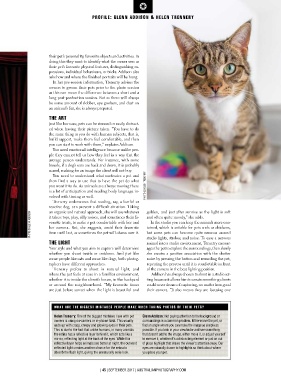
                       their pet’s personality, favourite objects and activities. In
                       doing this they want to identify what the owner sees as
                       their pet’s favourite physical features, distinguishing ex-
                       pressions, individual behaviours, or tricks. Addison also
                       asks how and where the finished portraits will be hung.
                        In her pre-session information, Trenerry advises the
                       owners to groom their pets prior to the photo session
                       as this can mean the difference between a short and a
                       long post production session. But as there will always
                       be some amount of slobber, eye goobers, and dust on
                       an animal’s fur, she is always prepared.
                       THE ART
                       Just like humans, pets can be stressed or easily distract-
                       ed when having their picture taken. “You have to do
                       the same thing as you do with human subjects, that is,
                       build rapport, make them feel comfortable, and then
                       you can start to work with them,” explains Addison.
                        You need emotional intelligence because unlike peo-
                       ple they cannot tell us how they feel in a way that the
                       average person understands. For instance, with some
                       breeds, if a dog’s ears are back and down, it is probably
                       scared, making for an image the client will not buy.
                        You need to understand what motivates a pet and
                       then find a way to use that to have the pet do what
                       you want it to do. As animals are always moving there  PHOTO © HELEN TRENERRY
                       is a lot of anticipation and reading body language in-
                       volved with timing as well.
                        Trenerry underscores that reading, say, a fearful or
                       reactive dog, can prevent a difficult situation. Taking   golden, and just after sunrise as the light is soft
              PHOTO © GLENN ADDISON    it takes: toys, play, silly noises, and sometimes their fa-  and often quite moody,” she adds.
                       an organic and natural approach, she will use whatever
                       vourite treats, to make a pet comfortable with her and
                                                                    In the studio you can keep the animals more con-
                       her camera. But, she suggests, avoid their favourite
                                                                  tained, which is suitable for pets such as chickens,
                                                                  but some pets can become quite nervous around
                       item until last, as sometimes the pet will obsess over it.
                       THE LIGHT                                  studio lights, strobes, and noise. To ease a nervous
                                                                  animal into a studio environment, Trenerry encour-
                       Your style and what you aim to capture will determine   ages the pet to explore the surroundings, then slowly
                       whether you shoot inside or outdoors. And just like   she creates a positive association with the shutter
                       some people like cats and some like dogs, both photog-  noise by pressing the button and rewarding the pet,
                       raphers have different approaches.         repeating the process until it is comfortable in front
                        Trenerry prefers to shoot in natural light, and   of the camera in the best lighting position.
                       where the pet feels at ease in a familiar environment,    Addison has always chosen to shoot in a studio set-
                       whether it is inside the client’s house, in the backyard   ting because it allows him to create something clients
                       or around the neighbourhood. “My favourite times   could never dream of capturing, no matter how good
                       are just before sunset when the light is beautiful and   their camera. “It also means they are focusing one


                         W H AT A R E T H E B I G G E S T M I S TA K E S P E O P L E M A K E W H E N TA K I N G P H O T O S O F T H E I R P E T S?
                         Helen Trenerry: One of the biggest mistakes I see with pet   Glenn Addison: Not paying attention to the background or
                         owners is using on-camera or in-phone flash. This usually   surroundings is a common problem. Either move the pet, or
                         ends up with crazy, creepy and glowing eyes in their pets.   find an angle where you can make the image as simple as
                         This is due to the fact that unlike humans, in many animals   possible. If you look in your viewfinder and see something
                         the retina has a reflective layer behind it, which acts like a   that doesn’t add to the image, either move it, or adjust yourself
                         mirror, reflecting light at the back of the eyes. While this   to remove it, whether it’s a distracting element or just an out
                         reflective layer helps animals see better at night, the outward   of place highlight that draws the viewer’s attention away. Our
                         reflected light creates another chance for the retina to   eyes are naturally drawn to highlights so think about where
                         absorb the flash light, giving the unnaturally eerie look.  you place your pet.


                                              | 45 | SEPTEMBER 2017 | AUSTRALIANPHOTOGRAPHY.COM

