


Page 48 - Australian Photography - September 2017
P. 48
PROF I L E: GL E N N A DDISO N & H E L E N T R E N N E RY


                                                                hundred per cent on the pet’s personality, which comes
                                                                to life in its eyes. Outdoors, a landscape can be very com-
                                                                plimentary but it can also be a distraction,” he explains.
                                                                   But shooting in a studio can definitely have its chal-
                                                                lenges, like lighting black dogs on a black background,
                                                                which requires constant focus and technical mastery
                                                                throughout a shoot to get it right.
                                                                  And sometimes there is just no alternative. “I once
                                                                photographed a red belly black snake for Australian
                                                                Wildlife Rescue,” remembers Addison. “The combina-
                                                                tion of rapid movement towards and away from the cam-
                                                                era made it especially difficult to focus, and ensuring
                                                                good separation of the snake from a black background
                                                                made lighting a little tricky. But being in a studio was a
                                                                very safe and controllable way to photograph the snake.”

                                                                THE SHOOT
                                                                Like with all photography, location can greatly influ-
                                                                ence the composition. In a studio there are no natu-
                                                                rally occurring lines, shapes, textures, colours and pat-
                                                                terns, while outdoors the location, personality of the pet,
                                                                and above all, the available light and background will
                                                                all play a part. Finding smooth open shade and a back-
                                                                ground that is appealing and uncluttered can help here.
                                                                  For action shots, Trenerry first looks for good light since
                                                                she needs to use a fast shutter speed to freeze the action.
                                                                “I aim for at least 1/1000 of a second, while bumping up
                                                                the ISO to counteract the fast shutter speed,” she explains.
                                                                She chooses a fairly shallow depth of field, say an aper-
                                                                ture of f2.8-f4, because she likes a blurry background. But
                                                                this does pose its own problems. “Having a very narrow
                                                                field of focus, with running dogs especially, can get quite
                                                                tricky.”  In a session, she will use all her lenses but her
                                                                favourite is the Canon EF 70-200 mm f/2.8 L II USM.
                                                              PHOTO © HELEN TRENERRY   do their favourite activity, such as running, jumping, and
                                                                It lets her move back enough to give dogs some space to
                                                                catching balls, before taking the shots.
                                                                  For Addison, setting up for an action shot is about put-
                                                                ting himself in the right position and providing some-
                                                                thing for the pet to focus its attention. If he wants a dog to
                                                                appear to be flying out of the image he will have an assis-
                                                                tant take the dog three meters away from him at around a
                                                                45 degree angle. The assistant will bounce a ball towards
                                                                him at a speed so the dog can catch up to it but just not
                                                                catch it. Bouncing the ball at different heights will get dif-
                                                                ferent body angles. It is important to make sure that ev-
                                                                erything comes together to complete the concept of the
                                                                shoot, for example, the facial expression and the shape of
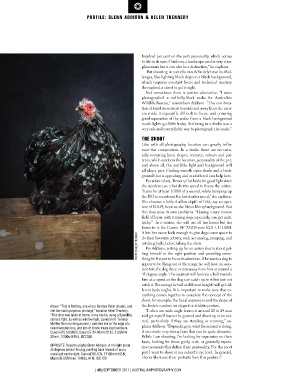
                       Above: “This is Mottley, one of our Bantam Pekin chooks, and   the body to capture an elegant or athletic posture.
                       she has such gorgeous plumage,” explains Helen Trennery.   “I often use wide angle lenses at around 20 to 24 mm
                       “This shot was taken at home, in my studio, using a Speedlite,   and get myself low to the ground and shoot up at an ani-
                       camera right, as well as window light, camera left. To keep   mal, particularly if they are standing or running,” ex-
                       Mottley from running around, I perched her on the edge of a
                       raised wooden box, and lots of chook treats kept her there.   plains Addison. “Depending on what the animal is doing,
                       Canon EOS 5D MKIII, Canon EF 24-70mm f2.8 L II USM @   it can create very strong lines that can be quite dramatic.
                       33mm, 1/200s @ f5.6, ISO 200.            While I am shooting, I’m looking for expression on their
                                                                faces, looking for those goofy, cute, or generally expres-
                       OPPOSITE: Rose the pig by Glenn Addison. A rim light about   sive moments that define their personality. For the most
                       45 degrees behind the pig, pointing back towards it and a
                       main light on the right. Canon EOS-1DX, EF100mm f/2.8L   part I want to shoot at my subject’s eye level. In general,
                       Macro IS USM lens. 1/180s, @ f8, ISO 100.  clients like to see their portraits from this position.”

                                            | 48 | SEPTEMBER 2017 | AUSTRALIANPHOTOGRAPHY.COM

