


Page 14 - April 2018
P. 14
Norm’s first mission took four hours and involved no       Of one captain who also flew NAO’s large,
        fewer than 60 drops. That works out to about one drop      underpowered Cansos in the 1980s and 1990s,
        every three minutes or so.  There are no computers or      Norm said, “he liked the Canso, but he LOVES the
        bombsights in use.  It’s an art and science shaped by      turbines.”
        experience, affected by things like wind direction and
                                                                   One memorable fire in 2014 was in the Yellowknife
        honed by feedback from the bird dog. (Norm has also
                                                                   area. Good weather in Saskatchewan meant Norm’s
        seen an experienced crew spot a lone tree that was
                                                                   aircraft and several other were deployed there for
        “candling” or bursting into flame, then extinguish it with
                                                                   three days before “the wind shifted and the
        one well-placed load “without even tipping over the        community was saved.”
        plastic outhouse.”) Crews take pains to avoid coming into
        too low, lest their load of retardant “snap off trees -- and
        the ground crews have to crawl all over that to put out a
        fire.”
        Norm and his captain had a ritual: whenever they
        dropped and the bird dog called “bulls eye”, they got an
        M&M!


                                                                   The largest fire on which he’s worked had nine
                                                                   aircraft working on it. Not one, but two, bird dogs
                                                                   were needed to oversee everything.  Norm was
                                                                   flying for WestJet in the summer of 2017. When the
                                                                   weather over northern Saskatchewan was good but
                                                                   fires were burning fiercely in Montana. Several

                                                                   Saskatchewan 215Ts, he heard, were dispatched to
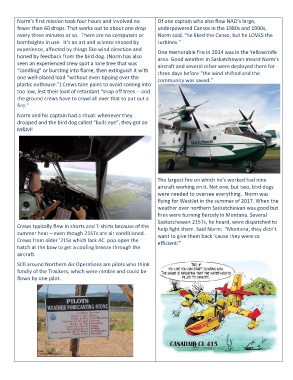
        Crews typically flew in shorts and T-shirts because of the
                                                                   help fight them. Said Norm:  “Montana, they didn’t
        summer heat – even though 215Ts are air conditioned.
                                                                   want to give them back ’cause they were so
        Crews from older ‘215s which lack AC  pop open the         efficient!”
        hatch at the bow to get a cooling breeze through the
        aircraft.
        Still around Northern Air Operations are pilots who think
        fondly of the Trackers, which were nimble and could be
        flown by one pilot.

