


Page 17 - 2026 Nonprofit Industry Trends
P. 17
NAVIGATING THE FUTURE OF NONPROFIT HR - CONTINUED
 15                                                                                                                                                                 16


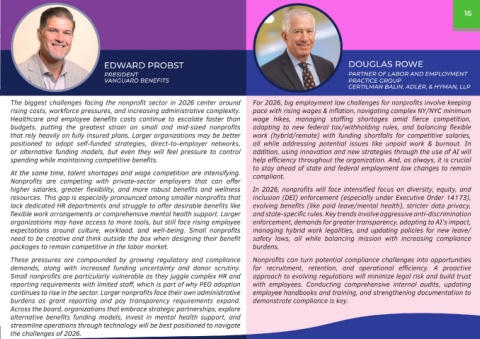
                                     EDWARD PROBST                                                                         DOUGLAS ROWE
 SUCCESSION PLANNING                  PRESIDENT                                                                            PARTNER OF LABOR AND EMPLOYMENT

                                      VANGUARD BENEFITS                                                                    PRACTICE GROUP
                                                                                                                           CERTILMAN BALIN, ADLER, & HYMAN, LLP

 STRATEGIC PRIORITIES FOR    LONG-TERM INVESTMENT:  The biggest challenges facing the nonprofit sector in 2026 center around   For 2026, big employment law challenges for nonprofits involve keeping

 NONPROFIT LEADERS     rising costs, workforce pressures, and increasing administrative complexity.   pace with rising wages & inflation, navigating complex NY/NYC minimum
 ► Create  data-driven  workforce  planning  capabilities  that  anticipate   Healthcare  and  employee  benefits  costs  continue  to  escalate  faster  than   wage  hikes,  managing  staffing  shortages  amid  fierce  competition,
 To align HR strategy with 2026’s business realities, nonprofit leaders   (rather than react to) talent challenges.  budgets,  putting  the  greatest  strain  on  small  and  mid-sized  nonprofits   adapting  to  new  federal  tax/withholding  rules,  and  balancing  flexible
 should prioritize:  ► Develop  flexible  talent  ecosystems  that  support  various  work   that rely heavily on fully insured plans. Larger organizations may be better   work  (hybrid/remote)  with  funding  shortfalls  for  competitive  salaries,
 arrangements while maintaining mission alignment and collaborative   positioned  to  adopt  self-funded  strategies,  direct-to-employer  networks,   all while addressing  potential issues  like unpaid work & burnout.  In
 IMMEDIATE ACTIONS:  culture.  or  alternative  funding  models,  but  even  they  will  feel  pressure  to  control   addition, using innovation and new strategies through the use of AI will

 ► Foster  resilient  organizational  cultures  where  adaptability,  learning,   spending while maintaining competitive benefits.  help efficiency throughout the organization. And, as always, it is crucial
 ► Conduct an honest assessment of current HR technology and identify   and innovation are celebrated.  At the same time, talent shortages and wage competition are intensifying.   to stay ahead of state and federal employment law changes to remain
 critical gaps limiting strategic capability.  Nonprofits  are  competing  with  private-sector  employers  that  can  offer   compliant.

 ► Develop clear AI adoption roadmaps with change management plans   MOVING FORWARD  higher  salaries,  greater  flexibility,  and  more  robust  benefits  and  wellness   In 2026, nonprofits will face intensified focus on diversity, equity, and
 that address employee concerns and build competency.  resources. This gap is especially pronounced among smaller nonprofits that   inclusion (DEI) enforcement (especially under Executive Order 14173),

 ► Begin shifting recruitment practices toward skills-based approaches,   The nonprofits that will lead in 2026 are those that recognize workforce   lack dedicated HR departments and struggle to offer desirable benefits like   evolving benefits (like paid leave/mental health), stricter data privacy,
 revising job descriptions and interview processes accordingly.  challenges as opportunities for transformation. By proactively aligning   flexible work arrangements or comprehensive mental health support. Larger   and state-specific rules. Key trends involve aggressive anti-discrimination
 HR  strategies  with  technological  advancement,  evolving  workforce   organizations may have access to more tools, but still face rising employee   enforcement, demands for greater transparency, adapting to AI’s impact,
 ONGOING FOCUS:  expectations, and changing business cultures, organizations can build   expectations  around  culture,  workload,  and  well-being.  Small  nonprofits   managing hybrid work legalities, and updating policies for new leave/
 workplaces where talented people choose to build careers in service of
 mission.  need to be creative and think outside the box when designing their benefit     safety  laws,  all  while  balancing  mission  with  increasing  compliance
 ► Embed continuous  learning into organizational culture through   packages to remain competitive in the labor market.  burdens.
 accessible micro-learning, cross-functional projects, and clear career   The  future  of  nonprofit  HR  is  not  about  managing  change;  it’s  about
 pathways.  leading  it.  As  you  craft  your  2026  strategy,  consider  how  these   These pressures are compounded by growing regulatory and compliance   Nonprofits can turn potential compliance challenges into opportunities
 ► Position HR leadership as strategic contributors to mission delivery, not   trends intersect with your organizational context and where targeted   demands,  along  with  increased  funding  uncertainty  and  donor  scrutiny.   for  recruitment,  retention,  and  operational  efficiency.  A  proactive
     Small nonprofits are particularly vulnerable as they juggle complex HR and
                                                                                          approach to evolving regulations will minimize legal risk and build trust
 administrative support.  investments in people practices can drive the greatest mission impact.  reporting requirements with limited staff, which is part of why PEO adoption   with  employees.  Conducting  comprehensive  internal  audits,  updating
 ► Build  organizational  change  capacity  through  transparent  continues to rise in the sector. Larger nonprofits face their own administrative   employee handbooks and training, and strengthening documentation to
 communication,  employee  involvement,  and  recognition  of  change   burdens as grant reporting and pay transparency requirements expand.   demonstrate compliance is key.
 efforts.  JILL KRUMHOLZ
 FOUNDER & CEO  Across the board, organizations that embrace strategic partnerships, explore
 TALENT MANAGEMENT SOLUTIONS  alternative  benefits  funding  models,  invest  in  mental  health  support,  and
     streamline operations through technology will be best positioned to navigate
     the challenges of 2026.

