


Page 37 - 2026 Nonprofit Industry Trends
P. 37
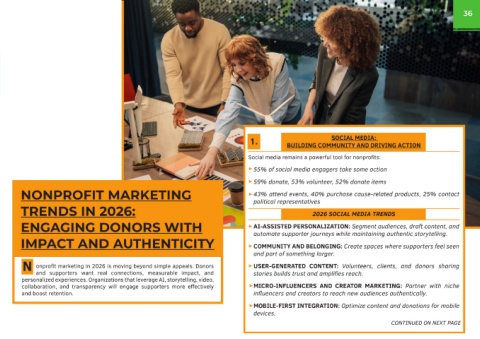
35                                                                                                                                                                 36


 RANDY MOLLAND  DAN DRUCKER

 OG FRACTIONAL   FOUNDER
 CHIEF GIVING OFFICER  PHILANTHROPY FUEL
 IMPACT CIRCLE NETWORK


 Nonprofits who are heavily reliant on grants are feeling nervous about their future because they   Corporations  are  becoming  far  more selective.  ESG and  DEI
 are dependent on government or foundation funding. Many are asking, “How do we diversify our   scrutiny,  brand-risk  concerns,  and  tighter  internal  approvals
 fundraising efforts?” and are left wondering where to start.   are slowing partnership decisions and raising the bar for proof
 of impact. Smaller nonprofits will feel this most, facing longer
 We expect more long-term grants to end abruptly, creating gaps that nonprofits will need to fill.   sales cycles, more compliance requests, and greater pressure to
 This will spark conversations about how to secure more unrestricted funding, allowing them to hire   articulate clear value. Mid-sized and larger organizations must   1.  SOCIAL MEDIA:
 fundraisers and development directors, not just program staff.  tighten  measurement,  unify  messaging,  and  align  programs   BUILDING COMMUNITY AND DRIVING ACTION

 The first place you can start is to build some relationships with business owners and corporate   directly  to  business  needs  such  as  workforce  engagement,   Social media remains a powerful tool for nonprofits:
 sponsors. But where do you find them?  regional impact, and trust-building.            ► 55% of social media engagers take some action

 LinkedIn.   Impact  reporting  is  moving  toward  greater  standardization.
 Corporations want fewer metrics, but clearer ones, simple KPIs                         ► 59% donate, 53% volunteer, 52% donate items
 There are over 250 million active CEO’s, founders, and high level executives on the platform, but   that tie community outcomes to business relevance. Employee   NONPROFIT MARKETING  ► 43% attend events, 40% purchase cause-related products, 25% contact
 there is only 43% of non-profits who have a profile, let alone the small fraction that are actually   engagement  will  remain  a  dominant  driver,  with  companies   political representatives
 active.   investing  in  experiences  that  support  culture,  retention,  and   TRENDS IN 2026:
 connection.  AI  will  play  a  larger  role  in  nonprofit  outreach,                                        2026 SOCIAL MEDIA TRENDS
 “But LinkedIn is for business owners and people looking for jobs”
 research,  and  reporting,  but  partners  will  increasingly  ask
 Not anymore...  for  transparency  around  data  use,  privacy,  and  attribution.   ENGAGING DONORS WITH  ► AI-ASSISTED PERSONALIZATION: Segment audiences, draft content, and
 Governance  and  due-diligence  reviews  will  also  expand,                             automate supporter journeys while maintaining authentic storytelling.
 LinkedIn is no longer just a job board. It’s the only platform where you can search for aligned   especially around brand safety and political neutrality.  IMPACT AND AUTHENTICITY
 companies,  connect  directly  with  decision-makers,  and  start  real  conversations  with  potential   ► COMMUNITY AND BELONGING: Create spaces where supporters feel seen
                                                                                          and part of something larger.
 corporate partners. You don’t need to go viral or build a huge following. You just need to show up   2026  will  reward  partnership-ready  organizations,  those
 consistently and position your mission in a way that speaks to business leaders. There is no other   that can clearly communicate what problems they solve for a   N  onprofit marketing in 2026 is moving beyond simple appeals. Donors   ► USER-GENERATED  CONTENT:  Volunteers,  clients,  and  donors  sharing
 platform like it.   company  and  how  the  impact  will  be  measured.  Nonprofits   and  supporters  want  real  connections,  measurable  impact,  and   stories builds trust and amplifies reach.
 should develop a concise Partnership Readiness Pack, including   personalized experiences. Organizations that leverage AI, storytelling, video,
 When used correctly, LinkedIn becomes a low-cost, high-impact fundraising channel helping you   a  program  menu,  KPIs,  employee  engagement  options,  and  a   collaboration,  and  transparency  will  engage  supporters  more  effectively   ► MICRO-INFLUENCERS AND CREATOR MARKETING: Partner  with  niche
 attract values-aligned companies that want to do good and are actively looking for ways to partner.  one-page  brand-safety  overview. They should  also shift  from   and boost retention.  influencers and creators to reach new audiences authentically.
 “sponsorship”  language  to  a  business-collaboration  mindset,
 The nonprofits that learn how to use LinkedIn today will be the ones leading tomorrow with stronger   ► MOBILE-FIRST INTEGRATION: Optimize content and donations for mobile
 relationships, better funding, and more resilient missions.  showing how their mission advances workforce, community, or   devices.
 trust priorities. Finally, co-creating a shared quarterly scorecard
 If you are looking to diversify your fundraising, I would get on LinkedIn, build relationships with   with  corporate partners  will strengthen  alignment  and  keep   CONTINUED ON NEXT PAGE
 corporate partners, and start looking to raise some unrestricted funds.   collaborations focused on measurable, mutual value.

