


Page 158 - [Uma_Sekaran]_Research_methods_for_business__a_sk(BookZZ.org)
P. 158
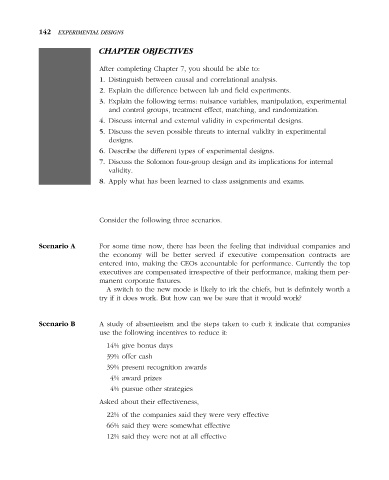
142  EXPERIMENTAL DESIGNS

                             CHAPTER OBJECTIVES

                             After completing Chapter 7, you should be able to:
                             1. Distinguish between causal and correlational analysis.
                             2. Explain the difference between lab and field experiments.
                             3. Explain the following terms: nuisance variables, manipulation, experimental
                               and control groups, treatment effect, matching, and randomization.
                             4. Discuss internal and external validity in experimental designs.
                             5. Discuss the seven possible threats to internal validity in experimental
                               designs.
                             6. Describe the different types of experimental designs.
                             7. Discuss the Solomon four-group design and its implications for internal
                               validity.
                             8. Apply what has been learned to class assignments and exams.


                             Consider the following three scenarios.


            Scenario A       For some time now, there has been the feeling that individual companies and
                             the economy will be better served if executive compensation contracts are
                             entered into, making the CEOs accountable for performance. Currently the top
                             executives are compensated irrespective of their performance, making them per-
                             manent corporate fixtures.
                               A switch to the new mode is likely to irk the chiefs, but is definitely worth a
                             try if it does work. But how can we be sure that it would work?


            Scenario B       A study of absenteeism and the steps taken to curb it indicate that companies
                             use the following incentives to reduce it:
                               14% give bonus days
                               39% offer cash
                               39% present recognition awards
                                4% award prizes
                                4% pursue other strategies
                             Asked about their effectiveness,
                               22% of the companies said they were very effective
                               66% said they were somewhat effective
                               12% said they were not at all effective

