


Page 169 - [Uma_Sekaran]_Research_methods_for_business__a_sk(BookZZ.org)
P. 169
FACTORS AFFECTING INTERNAL VALIDITY  153

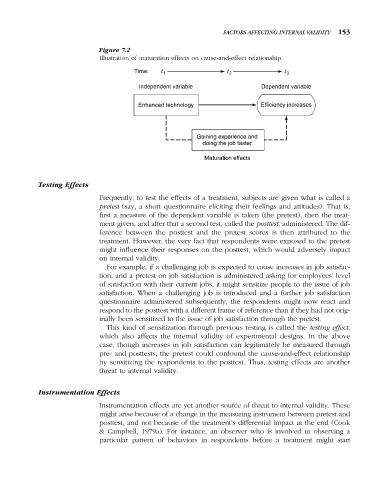
                             Figure 7.2
                             Illustration of maturation effects on cause-and-effect relationship.
                                      Time:   t 1               t 2             t 3

                                        Independent variable              Dependent variable

                                       Enhanced technology               Efficiency increases


                                                        Gaining experience and
                                                         doing the job faster

                                                          Maturation effects


            Testing Effects
                             Frequently, to test the effects of a treatment, subjects are given what is called a
                             pretest (say, a short questionnaire eliciting their feelings and attitudes). That is,
                             first a measure of the dependent variable is taken (the pretest), then the treat-
                             ment given, and after that a second test, called the posttest, administered. The dif-
                             ference between the posttest and the pretest scores is then attributed to the
                             treatment. However, the very fact that respondents were exposed to the pretest
                             might influence their responses on the posttest, which would adversely impact
                             on internal validity.
                               For example, if a challenging job is expected to cause increases in job satisfac-
                             tion, and a pretest on job satisfaction is administered asking for employees’ level
                             of satisfaction with their current jobs, it might sensitize people to the issue of job
                             satisfaction. When a challenging job is introduced and a further job satisfaction
                             questionnaire administered subsequently, the respondents might now react and
                             respond to the posttest with a different frame of reference than if they had not orig-
                             inally been sensitized to the issue of job satisfaction through the pretest.
                               This kind of sensitization through previous testing is called the testing effect,
                             which also affects the internal validity of experimental designs. In the above
                             case, though increases in job satisfaction can legitimately be measured through
                             pre- and posttests, the pretest could confound the cause-and-effect relationship
                             by sensitizing the respondents to the posttest. Thus, testing effects are another
                             threat to internal validity.


            Instrumentation Effects
                             Instrumentation effects are yet another source of threat to internal validity. These
                             might arise because of a change in the measuring instrument between pretest and
                             posttest, and not because of the treatment’s differential impact at the end (Cook
                             & Campbell, 1979a). For instance, an observer who is involved in observing a
                             particular pattern of behaviors in respondents before a treatment might start

