


Page 164 - [Uma_Sekaran]_Research_methods_for_business__a_sk(BookZZ.org)
P. 164
148  EXPERIMENTAL DESIGNS

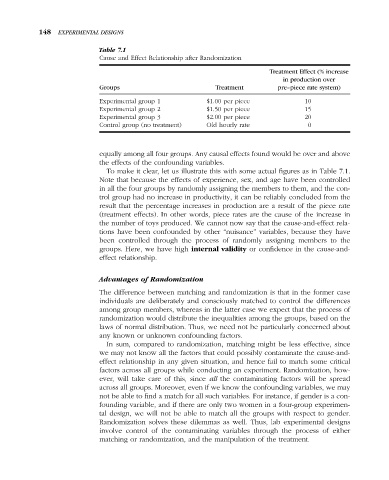
                             Table 7.1
                             Cause and Effect Relationship after Randomization
                                                                            Treatment Effect (% increase
                                                                                in production over
                             Groups                          Treatment        pre–piece rate system)
                             Experimental group 1         $1.00 per piece             10
                             Experimental group 2         $1.50 per piece             15
                             Experimental group 3         $2.00 per piece             20
                             Control group (no treatment)  Old hourly rate            0


                             equally among all four groups. Any causal effects found would be over and above
                             the effects of the confounding variables.
                               To make it clear, let us illustrate this with some actual figures as in Table 7.1.
                             Note that because the effects of experience, sex, and age have been controlled
                             in all the four groups by randomly assigning the members to them, and the con-
                             trol group had no increase in productivity, it can be reliably concluded from the
                             result that the percentage increases in production are a result of the piece rate
                             (treatment effects). In other words, piece rates are the cause of the increase in
                             the number of toys produced. We cannot now say that the cause-and-effect rela-
                             tions have been confounded by other “nuisance” variables, because they have
                             been controlled through the process of randomly assigning members to the
                             groups. Here, we have high internal validity or confidence in the cause-and-
                             effect relationship.


                             Advantages of Randomization
                             The difference between matching and randomization is that in the former case
                             individuals are deliberately and consciously matched to control the differences
                             among group members, whereas in the latter case we expect that the process of
                             randomization would distribute the inequalities among the groups, based on the
                             laws of normal distribution. Thus, we need not be particularly concerned about
                             any known or unknown confounding factors.
                               In sum, compared to randomization, matching might be less effective, since
                             we may not know all the factors that could possibly contaminate the cause-and-
                             effect relationship in any given situation, and hence fail to match some critical
                             factors across all groups while conducting an experiment. Randomization, how-
                             ever, will take care of this, since all the contaminating factors will be spread
                             across all groups. Moreover, even if we know the confounding variables, we may
                             not be able to find a match for all such variables. For instance, if gender is a con-
                             founding variable, and if there are only two women in a four-group experimen-
                             tal design, we will not be able to match all the groups with respect to gender.
                             Randomization solves these dilemmas as well. Thus, lab experimental designs
                             involve control of the contaminating variables through the process of either
                             matching or randomization, and the manipulation of the treatment.

