


Page 240 - [Uma_Sekaran]_Research_methods_for_business__a_sk(BookZZ.org)
P. 240
224  DATA COLLECTION METHODS

                                         DETAILS OF STUDY                  MEASUREMENT

                     Purpose of the  Types of     Extent of researcher       Measurement
                                                                  Study setting
                       study       investigation    interference             and measures
                                                                                           DATA
                                                                            Operational  ANALYSIS
                                 Establishing:                                definition
                    Exploration  – Causal relationships  Minimal: Studying events  Contrived
                                                as they normally occur
                    Description  – Correlations                             Items (measure)  1. Feel for
                    Hypothesis testing  – Group differences,  Manipulation and/or  Noncontrived  Scaling      data
                                                control and/or simulation
                                                                            Categorizing
                                    ranks, etc.                             Coding
                 PROBLEM STATEMENT                                                      2. Goodness of
                                                                                            data

                    Unit of analysis
                                    Sampling          Time                  Data-collection
                     (population to
                                     design          horizon                  method
                      be studied)
                                                                                        3. Hypotheses
                     Individuals   Probability/   One-shot                  Interviewing      testing
                                     nonprobability
                     Dyads                          (cross sectional)       Questionnaire
                     Groups        Sample         Longitudinal
                                     size (n)                               Observation
                     Organizations
                                                                            Unobtrusive
                     Machines                                               methods
                       etc.
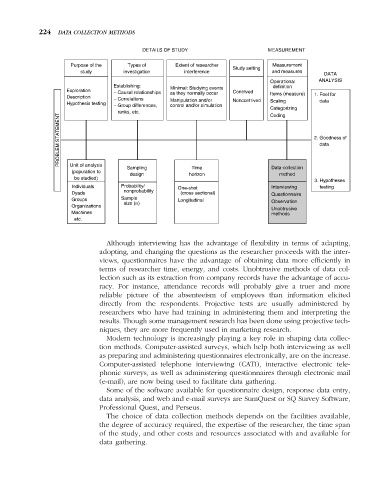
                               Although interviewing has the advantage of flexibility in terms of adapting,
                             adopting, and changing the questions as the researcher proceeds with the inter-
                             views, questionnaires have the advantage of obtaining data more efficiently in
                             terms of researcher time, energy, and costs. Unobtrusive methods of data col-
                             lection such as its extraction from company records have the advantage of accu-
                             racy. For instance, attendance records will probably give a truer and more
                             reliable picture of the absenteeism of employees than information elicited
                             directly from the respondents. Projective tests are usually administered by
                             researchers who have had training in administering them and interpreting the
                             results. Though some management research has been done using projective tech-
                             niques, they are more frequently used in marketing research.
                               Modern technology is increasingly playing a key role in shaping data collec-
                             tion methods. Computer-assisted surveys, which help both interviewing as well
                             as preparing and administering questionnaires electronically, are on the increase.
                             Computer-assisted telephone interviewing (CATI), interactive electronic tele-
                             phonic surveys, as well as administering questionnaires through electronic mail
                             (e-mail), are now being used to facilitate data gathering.
                               Some of the software available for questionnaire design, response data entry,
                             data analysis, and web and e-mail surveys are SumQuest or SQ Survey Software,
                             Professional Quest, and Perseus.
                               The choice of data collection methods depends on the facilities available,
                             the degree of accuracy required, the expertise of the researcher, the time span
                             of the study, and other costs and resources associated with and available for
                             data gathering.

