


Page 260 - [Uma_Sekaran]_Research_methods_for_business__a_sk(BookZZ.org)
P. 260
244  DATA COLLECTION METHODS

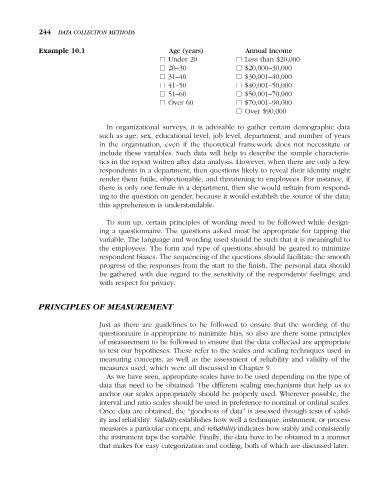
            Example 10.1                        Age (years)          Annual Income
                                                 Under 20              Less than $20,000
                                                 20–30                 $20,000–30,000
                                                 31–40                 $30,001–40,000
                                                 41–50                 $40,001–50,000
                                                 51–60                 $50,001–70,000
                                                 Over 60               $70,001–90,000
                                                                       Over $90,000

                               In organizational surveys, it is advisable to gather certain demographic data
                             such as age, sex, educational level, job level, department, and number of years
                             in the organization, even if the theoretical framework does not necessitate or
                             include these variables. Such data will help to describe the sample characteris-
                             tics in the report written after data analysis. However, when there are only a few
                             respondents in a department, then questions likely to reveal their identity might
                             render them futile, objectionable, and threatening to employees. For instance, if
                             there is only one female in a department, then she would refrain from respond-
                             ing to the question on gender, because it would establish the source of the data;
                             this apprehension is understandable.

                               To sum up, certain principles of wording need to be followed while design-
                             ing a questionnaire. The questions asked must be appropriate for tapping the
                             variable. The language and wording used should be such that it is meaningful to
                             the employees. The form and type of questions should be geared to minimize
                             respondent biases. The sequencing of the questions should facilitate the smooth
                             progress of the responses from the start to the finish. The personal data should
                             be gathered with due regard to the sensitivity of the respondents’ feelings, and
                             with respect for privacy.


            PRINCIPLES OF MEASUREMENT

                             Just as there are guidelines to be followed to ensure that the wording of the
                             questionnaire is appropriate to minimize bias, so also are there some principles
                             of measurement to be followed to ensure that the data collected are appropriate
                             to test our hypotheses. These refer to the scales and scaling techniques used in
                             measuring concepts, as well as the assessment of reliability and validity of the
                             measures used, which were all discussed in Chapter 9.
                               As we have seen, appropriate scales have to be used depending on the type of
                             data that need to be obtained. The different scaling mechanisms that help us to
                             anchor our scales appropriately should be properly used. Wherever possible, the
                             interval and ratio scales should be used in preference to nominal or ordinal scales.
                             Once data are obtained, the “goodness of data” is assessed through tests of valid-
                             ity and reliability. Validity establishes how well a technique, instrument, or process
                             measures a particular concept, and reliability indicates how stably and consistently
                             the instrument taps the variable. Finally, the data have to be obtained in a manner
                             that makes for easy categorization and coding, both of which are discussed later.

