


Page 263 - [Uma_Sekaran]_Research_methods_for_business__a_sk(BookZZ.org)
P. 263
GENERAL APPEARANCE OR “GETUP” OF THE QUESTIONNAIRE  247

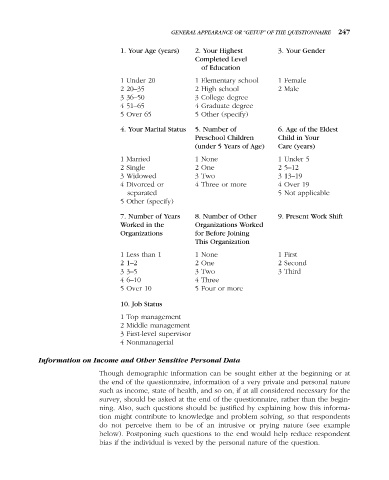
                                  1. Your Age (years)  2. Your Highest        3. Your Gender
                                                       Completed Level
                                                         of Education
                                  1 Under 20           1 Elementary school    1 Female
                                  2 20–35              2 High school          2 Male
                                  3 36–50              3 College degree
                                  4 51–65              4 Graduate degree
                                  5 Over 65            5 Other (specify)

                                  4. Your Marital Status  5. Number of        6. Age of the Eldest
                                                       Preschool Children     Child in Your
                                                       (under 5 Years of Age)  Care (years)
                                  1 Married            1 None                 1 Under 5
                                  2 Single             2 One                  2 5–12
                                  3 Widowed            3 Two                  3 13–19
                                  4 Divorced or        4 Three or more        4 Over 19
                                    separated                                 5 Not applicable
                                  5 Other (specify)

                                  7. Number of Years   8. Number of Other     9. Present Work Shift
                                  Worked in the        Organizations Worked
                                  Organizations        for Before Joining
                                                       This Organization

                                  1 Less than 1        1 None                 1 First
                                  2 1–2                2 One                  2 Second
                                  3 3–5                3 Two                  3 Third
                                  4 6–10               4 Three
                                  5 Over 10            5 Four or more
                                  10. Job Status
                                  1 Top management
                                  2 Middle management
                                  3 First-level supervisor
                                  4 Nonmanagerial

            Information on Income and Other Sensitive Personal Data
                             Though demographic information can be sought either at the beginning or at
                             the end of the questionnaire, information of a very private and personal nature
                             such as income, state of health, and so on, if at all considered necessary for the
                             survey, should be asked at the end of the questionnaire, rather than the begin-
                             ning. Also, such questions should be justified by explaining how this informa-
                             tion might contribute to knowledge and problem solving, so that respondents
                             do not perceive them to be of an intrusive or prying nature (see example
                             below). Postponing such questions to the end would help reduce respondent
                             bias if the individual is vexed by the personal nature of the question.

