


Page 31 - Demo
P. 31
“On October 17, 2018, cannabis became federally legal for commercial sale and consumption in Canada with co- existing frameworks for the recreational and medical cannabis market segments. As of September 2018, the total number of physicians that have ever provided medical cannabis authorization for a client reached 18,086 with physicians authorising an average of 2.1 grams/day per patient since January 2018”. – PwC Canada
KZN BLACK INDUSTRIALIST OF THE YEAR
ON A MISSION TO BOOST SA TEXTILE INDUSTRY
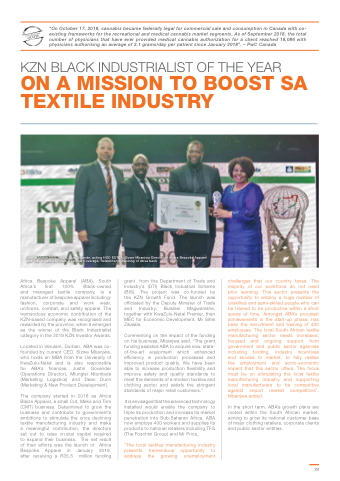
Neville Matjie CEO TIKZN, Siza Sibande, acting HOD EDTEA, Sizwe Mbanjwa Director of Africa Bespoke Apparel and Tozi Mthethwa Head: Regional Coverage, Relationship Banking of Absa bank
Africa Bespoke Apparel (ABA), South Africa’s first 100% Black-owned and managed textile company, is a manufacturer of bespoke apparel including: fashion, corporate and work wear, uniforms, combat, and safety apparel. The tremendous economic contribution of the KZN-based company was recognised and rewarded by the province, when it emerged as the winner of the Black Industrialist category in the 2019 KZN Investor Awards.
Located in Verulam, Durban, ABA was co- founded by current CEO, Sizwe Mbanjwa, who holds an MBA from the University of KwaZulu-Natal and is also responsible for ABA’s finances. Justin Govender (Operations Director), Mlungisi Ntombela (Marketing Logistics) and Dean Dunn (Marketing & New Product Development).
The company started in 2016 as Africa Blaize Apparel, a small Cut, Make and Trim (CMT) business. Determined to grow the business and contribute to government’s ambitions to stimulate the once declining textile manufacturing industry and make a meaningful contribution, the directors set out to raise crucial capital required to expand their business. The net result of their efforts was the launch of Africa Bespoke Apparel in January 2019, after receiving a R35.5 million funding
grant from the Department of Trade and Industry’s (DTI) Black Industrial Scheme (BIS). The project was co-funded by the KZN Growth Fund. The launch was officiated by the Deputy Minister of Trade and Industry, Bulelani Magwanishe, together with KwaZulu-Natal Premier, then MEC for Economic Development, Mr Sihle Zikalala.
Commenting on the impact of the funding on his business, Mbanjwa said, “The grant funding assisted ABA to acquire new, state- of-the-art equipment which enhanced efficiency in production processes and improved product quality. We have been able to increase production flexibility and improve safety and quality standards to meet the demands of a modern textiles and clothing sector and satisfy the stringent standards of major retail customers.”
It is envisaged that the advanced technology installed would enable the company to triple its production and increase its market penetration into Sub-Saharan Africa. ABA now employs 400 workers and supplies its products to national retailers including TFG (The Foschini Group) and Mr Price.
“The local textiles manufacturing industry presents tremendous opportunity to address the growing unemployment
challenges that our country faces. The majority of our workforce do not need prior learning. This sector presents the opportunity to employ a huge number of unskilled and semi-skilled people who can be trained to be productive within a short space of time. Amongst ABA’s proudest achievements in the start-up phase, has been the recruitment and training of 400 employees. The local South African textile manufacturing sector needs increased, focused and ongoing support from government and public sector agencies including funding, industry incentives and access to market, to fully realise the employment and socio-economic impact that this sector offers. The focus must be on stimulating the local textile manufacturing industry and supporting local manufacturers to be competitive against import market competitors”, Mbanjwa added.
In the short term, ABA’s growth plans are rooted within the South African market, aiming to grow its national customer base of major clothing retailers, corporate clients and public sector entities.
29


