


Page 254 - JoFA_2022
P. 254
TAX


                            interest, or capital appreciation;      Sec. 1091 wash-sale rules also apply to the day trader.
                          ■    Engage in substantial activity; and  He or she reports sales of securities on Schedule D,
                          ■    Carry on the activity with continuity and   Capital Gains and Losses, and on Form 8949, Sales
                            regularity (see IRS Publication 550, Invest-  and Other Dispositions of Capital Assets, as appropriate.
                            ment Income and Expenses, p. 68 (rev. March 10,   Although a day trader who qualifies as a trader in
                            2022)).                                 securities is considered as being in the business of
                            If these requirements are not met, the indi-  buying and selling securities, the trader is not subject
                          vidual will be considered an investor, not a trader   to self-employment tax on gains and losses on his or
                          in securities whose trading activity is treated   her sales of securities.
                          as a business. The determination of whether an   A day trader who qualifies as a trader in securi-
                          individual is a trader in securities is based on   ties is also allowed to deduct the expenses from his
                          the facts and circumstances of his or her trading   or her trading activity as business expenses because
                          activity. Factors relevant in determining whether   the trading activity is considered to be a business.
                          someone qualifies as a trader are discussed in   Deductible expenses could include equipment costs
                          IRS Topic No. 429 and summarized in the table   such as a computer or monitors, software for trading,
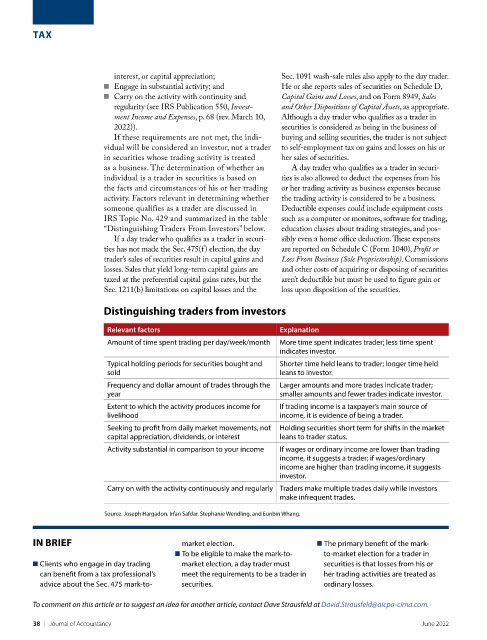
                          “Distinguishing Traders From Investors” below.  education classes about trading strategies, and pos-
                            If a day trader who qualifies as a trader in securi-  sibly even a home office deduction. These expenses
                          ties has not made the Sec. 475(f) election, the day   are reported on Schedule C (Form 1040), Profit or
                          trader’s sales of securities result in capital gains and   Loss From Business (Sole Proprietorship). Commissions
                          losses. Sales that yield long-term capital gains are   and other costs of acquiring or disposing of securities
                          taxed at the preferential capital gains rates, but the   aren’t deductible but must be used to figure gain or
                          Sec. 1211(b) limitations on capital losses and the   loss upon disposition of the securities.

                          Distinguishing traders from investors

                          Relevant factors                         Explanation
                          Amount of time spent trading per day/week/month  More time spent indicates trader; less time spent
                                                                   indicates investor.
                          Typical holding periods for securities bought and   Shorter time held leans to trader; longer time held
                          sold                                     leans to investor.
                          Frequency and dollar amount of trades through the   Larger amounts and more trades indicate trader;
                          year                                     smaller amounts and fewer trades indicate investor.
                          Extent to which the activity produces income for   If trading income is a taxpayer’s main source of
                          livelihood                               income, it is evidence of being a trader.
                          Seeking to profit from daily market movements, not  Holding securities short term for shifts in the market
                          capital appreciation, dividends, or interest  leans to trader status.
                          Activity substantial in comparison to your income  If wages or ordinary income are lower than trading
                                                                   income, it suggests a trader; if wages/ordinary
                                                                   income are higher than trading income, it suggests
                                                                   investor.
                          Carry on with the activity continuously and regularly Traders make multiple trades daily while investors
                                                                   make infrequent trades.
                          Source: Joseph Hargadon, Irfan Safdar, Stephanie Wendling, and Eunbin Whang.


         IN BRIEF                           market election.                ■  The primary benefit of the mark-
                                          ■  To be eligible to make the mark-to-  to-market election for a trader in
         ■   Clients who engage in day trading   market election, a day trader must   securities is that losses from his or
          can benefit from a tax professional’s   meet the requirements to be a trader in   her trading activities are treated as
          advice about the Sec. 475 mark-to-  securities.                     ordinary losses.

         To comment on this article or to suggest an idea for another article, contact Dave Strausfeld at David.Strausfeld@aicpa-cima.com.

         38    |   Journal of Accountancy                                                            June 2022

