


Page 26 - Demo-1
P. 26
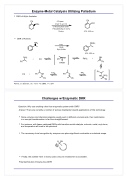
Enzyme-Metal Catalysis Utilizing Palladium
DKR of Allylic Acetates
Ph
OAc
NH2
PF lipase 37-40 oC, pH 7.0
0.1M phosphate buffer PdCl2(MeCN)2 (5 mol%)
19 days
Pd/C
CALB Et3N, EtOAc
Ph
81%, 96% ee
NHAc
64%, 99% ee
OH
DKR of Amines
NH2+Pd PhNH PdH2+NH
Ph
HPdH
Ph N
Ph
Ph
HN NH2
Ph
Pd
+
Ph NH Ph
PdH2
-NH3
Ph
Pamies, O.; Backvall, J.-E. Chem. Rev. 2003, 103, 3247
Challenges w/Enzymatic DKR
Question: Why use anything other than enzymatic systems with DKR?
Answer: There are currently a number of serious drawbacks towards applications of this technology.
Since enzymes and chemical catalysts usually work in different environments, their combination in a one-pot transformation in far from straightforward.
For instance, with lipase catalyzed DKRs with transition-metal catalysts, solvents, metal, acyl donor, and temperature all need to be optimized.
The necessary chiral recognition by enzymes can place significant constraints on substrate scope.
H OH ML
Finally, the achilles' heel: in many cases only one enantiomer is accessible. Potential Solution: Enzyme-free DKR!


