


Page 259 - PPL BEG-engelsk
P. 259
Meteorology

                However,  if  you  come  from  the  leeward  side,  you  may  encounter  severe

                turbulence in the form of rotor winds. One moment, you are climbing at 1000

                feet per minute, and the next moment, you’re descending at 2000 feet per

                minute.

                This is obviously a dangerous situation.

                If  wave  clouds,  the  lens-shaped  Alto  Cumulus  Lenticularis,  are  present,  this

                indicates conditions where rotors might be hidden on the leeward side. Thus,

                mountains should be flown over at a safe altitude.


                3.4.4.5     Valley winds and mountain winds


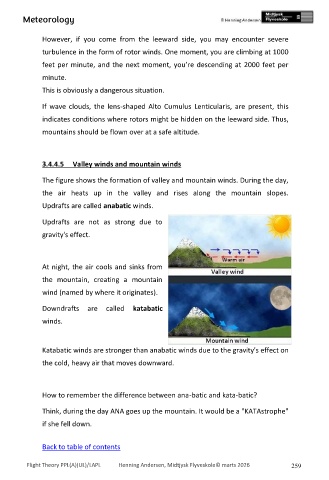
                The figure shows the formation of valley and mountain winds. During the day,

                the  air  heats  up  in  the  valley  and  rises  along  the  mountain  slopes.

                Updrafts are called anabatic winds.

                Updrafts  are  not  as  strong  due  to

                gravity's effect.


                At night, the air cools and sinks from
                the  mountain,  creating  a  mountain

                wind (named by where it originates).


                Downdrafts  are  called  katabatic

                winds.


                Katabatic winds are stronger than anabatic winds due to the gravity's effect on

                the cold, heavy air that moves downward.


                How to remember the difference between ana-batic and kata-batic?


                Think, during the day ANA goes up the mountain. It would be a "KATAstrophe"

                if she fell down.


                Back to table of contents


           Flight Theory PPL(A)(UL)/LAPL             Henning Andersen, Midtjysk Flyveskole© marts 2026     259

