


Page 3290 - Cote clinical veterinary advisor dogs and cats 4th
P. 3290
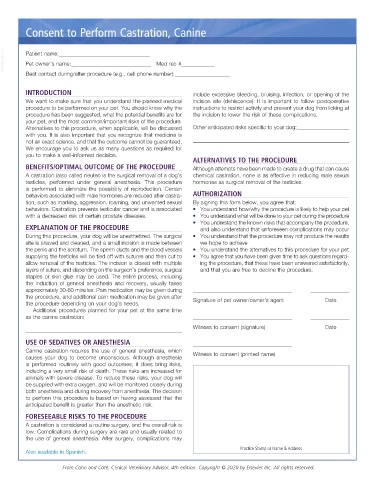
Consent to Perform Castration, Canine


  VetBooks.ir  Patient name:_________________________________
         Pet owner’s name:_____________________________  Med rec #____________
         Best contact during/after procedure (e.g., cell phone number):____________________


         INTRODUCTION                                           include excessive bleeding, bruising, infection, or opening of the
         We want to make sure that you understand the planned medical   incision  site (dehiscence).  It is  important  to follow postoperative
         procedure to be performed on your pet. You should know why the   instructions to restrict activity and prevent your dog from licking at
         procedure has been suggested, what the potential benefits are for   the incision to lower the risk of these complications.
         your pet, and the most common/important risks of the procedure.
         Alternatives to this procedure, when applicable, will be discussed   Other anticipated risks specific to your dog:___________________
         with you. It is also important that you recognize that medicine is
         not an exact science, and that the outcome cannot be guaranteed.   _________________________________________________________
         We encourage you to ask us as many questions as required for
         you to make a well-informed decision.
                                                                ALTERNATIVES TO THE PROCEDURE
         BENEFITS/OPTIMAL OUTCOME OF THE PROCEDURE              Although attempts have been made to create a drug that can cause
         A castration (also called neuter) is the surgical removal of a dog’s   chemical castration, none is as effective in reducing male sexual
         testicles, performed under general anesthesia. This procedure   hormones as surgical removal of the testicles.
         is performed to eliminate the possibility of reproduction. Certain
         behaviors associated with male hormones are reduced after castra-  AUTHORIZATION
         tion, such as marking, aggression, roaming, and unwanted sexual   By signing this form below, you agree that:
         behaviors. Castration prevents testicular cancer and is associated   •  You understand how/why the procedure is likely to help your pet
         with a decreased risk of certain prostate diseases.    •  You understand what will be done to your pet during the procedure
                                                                •  You understand the known risks that accompany the procedure,
         EXPLANATION OF THE PROCEDURE                             and also understand that unforeseen complications may occur
         During this procedure, your dog will be anesthetized. The surgical   •  You understand that the procedure may not produce the results
         site is shaved and cleaned, and a small incision is made between   we hope to achieve
         the penis and the scrotum. The sperm ducts and the blood vessels   •  You understand the alternatives to this procedure for your pet
         supplying the testicles will be tied off with sutures and then cut to   •  You agree that you have been given time to ask questions regard-
         allow removal of the testicles. The incision is closed with multiple   ing the procedure, that these have been answered satisfactorily,
         layers of suture, and depending on the surgeon’s preference, surgical   and that you are free to decline the procedure.
         staples or skin glue may be used. The entire process, including
         the induction of general anesthesia and recovery, usually takes
         approximately 30-60 minutes. Pain medication may be given during   ____________________________________  ______________
         the procedure, and additional pain medication may be given after
         the procedure depending on your dog’s needs.           Signature of pet owner/owner’s agent       Date
            Additional procedures planned for your pet at the same time
         as the canine castration:                              ____________________________________  ______________
                                                                Witness to consent (signature)             Date
         ____________________________________________________________
         USE OF SEDATIVES OR ANESTHESIA                         ____________________________________
         Canine castration requires the use of general anesthesia, which
         causes your dog to become unconscious. Although anesthesia   Witness to consent (printed name)
         is performed routinely with good outcomes, it does bring risks,
         including a very small risk of death. These risks are increased for
         animals with severe disease. To reduce these risks, your dog will
         be supplied with extra oxygen, and will be monitored closely during
         both anesthesia and during recovery from anesthesia. The decision
         to perform this procedure is based on having assessed that the
         anticipated benefit is greater than the anesthetic risk.
         FORESEEABLE RISKS TO THE PROCEDURE
         A castration is considered a routine surgery, and the overall risk is
         low. Complications during surgery are rare and usually related to
         the use of general anesthesia. After surgery, complications may
                                                                               Practice Stamp or Name & Address
         Also available in Spanish.

                     From Cohn and Côté: Clinical Veterinary Advisor, 4th edition. Copyright © 2020 by Elsevier Inc. All rights reserved.

