


Page 151 - Six Sigma Advanced Tools for Black Belts and Master Black Belts
P. 151
Char Count= 0
                         2:57
          August 31, 2006
 JWBK119-10
        136       Process Capability Analysis for Non-Normal Data with MINITAB
                                   Process Capability of Data
                            Using Box-Cox Transformation With Lambda = -3
                              USL
                  Process Data           transformed data         Within
                LSL                                              Overall
                Target
                USL    91.00000                               Potential (Within) Capability
                Sample Mean 12.61467                             Cp
                Sample N   30                                    CPL  1.19
                                                                 CPU
                StDev (Within)  1.38157
                StDev (Overall) 1.38157                          Cpk  1.19
                                                                     1.19
                                                                 CCpk
                 After Transformation
                LSL                                             Overall Capability
                Target                                           Pp
                                                                 PPL
                USL     0.00000                                  PPU  1.19
                Sample Mean  0.00053                             Ppk  1.19
                StDev (Within)  0.00015                          Cpm
                StDev (Overall) 0.00015
                             0.0000  0.0002  0.0004  0.0006  0.0008
                Observed Performance  Exp. Within Performance  Exp. Overall Performance
                PPM < LSL   PPM > LSL   PPM > LSL
                PPM > USL  0.00  PPM < USL  179.41  PPM < USL  179.41
                PPM Total  0.00  PPM Total  179.41  PPM Total  179.41
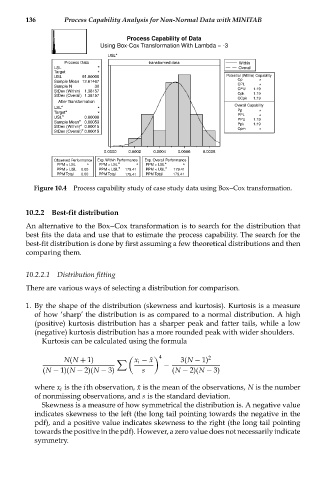
          Figure 10.4 Process capability study of case study data using Box--Cox transformation.
        10.2.2 Best-fit distribution

        An alternative to the Box--Cox transformation is to search for the distribution that
        best fits the data and use that to estimate the process capability. The search for the
        best-fit distribution is done by first assuming a few theoretical distributions and then
        comparing them.


        10.2.2.1 Distribution fitting
        There are various ways of selecting a distribution for comparison.

        1. By the shape of the distribution (skewness and kurtosis). Kurtosis is a measure
          of how ‘sharp’ the distribution is as compared to a normal distribution. A high
          (positive) kurtosis distribution has a sharper peak and fatter tails, while a low
          (negative) kurtosis distribution has a more rounded peak with wider shoulders.
            Kurtosis can be calculated using the formula

                  N(N + 1)             x i − ¯x    4  3(N − 1) 2
                                             −
             (N − 1)(N − 2)(N − 3)     s       (N − 2)(N − 3)

          where x i is the ith observation, ¯x is the mean of the observations, N is the number
          of nonmissing observations, and s is the standard deviation.
            Skewness is a measure of how symmetrical the distribution is. A negative value
          indicates skewness to the left (the long tail pointing towards the negative in the
          pdf), and a positive value indicates skewness to the right (the long tail pointing
          towards the positive in the pdf). However, a zero value does not necessarily indicate
          symmetry.

