


Page 11 - Edwards AFB Desert Wings 6-26-15
P. 11
2014 Consumer Confidence Report
                Annual Water Quality Report
               Edwards Air Force Base AFRL

Este reporte contiene información muy importante sobre agua potable. Tradúzcalo ó hable con alguien que lo entienda bien.
INTRODUCTION

  This is an annual report on the water quality delivered by Edwards Air Force Base.
The Bioenvironmental Engineering Flight, tests the drinking water quality for many
constituents as required by state and federal regulations. This report shows our monitor-
ing results from Jan. 1 to Dec. 31, 2014. We are pleased to inform you, that our water
system has met drinking water requirements outlined by the U.S. Air Force, state and
federal standards. These requirements are outlined in Title 22 articles 2 to 5.5, 15 to 16,
and AFI 48-144.

WHERE OUR WATER COMES FROM

  The EAFB AFRL Drinking Water System draws water from one source: On-base
ground water wells.

  We have three on-base ground water wells that are chlorinated at a booster station and
sent through the distribution station. These wells are fed by the Antelope Valley Aquifer.

TERMS USED IN THIS REPORT                                                                                                                                                                                                                              Air Force photograph

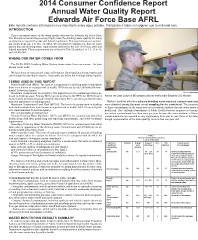
  Public Health Goal (PHG): The level of a contaminant in drinking water below which         Airman 1st Class Lovlyn of BE analyzes chlorine levels at the Edwards CDC Kitchen.
there is no known or expected risk to health. PHGs are set by the California Environ-
mental Protection Agency.                                                                      Tables 1 to 4 list all of the primary drinking water standard contaminants that
                                                                                             were detected during the most recent sampling for the constituent. The presence
  Maximum Contaminant Level (MCL) The highest level of a contaminant that is al-             of these contaminants in the water does not necessarily indicate that the water poses a
lowed in drinking water. Primary MCLs are set as close to the PHGs (or MCLGs) as is          health risk. The California Department of Public Health Services requires us to moni-
economically and technologically feasible. Secondary MCLs are set to protect the odor,       tor certain contaminants less than once per year because the concentrations of these
taste and appearance of drinking water.                                                      contaminants are not expected to vary significantly from year to year. Some of the data,
                                                                                             though representative of the water quality, is more than one-year old.
  Maximum Contaminant Level Goal (MCLG): The level of a contaminant in drinking
water below which there is no known or expected risk to health. MCLGs are set by the                                                          Table 1
U.S. Environmental Protection Agency.                                                                                        Primary Drinking Water Standard

  ND: not detectable at testing limit                                                                                                 1 Jan to 31 Dec 2014
  Primary Drinking Water Standards: MCLs and MRDLs for contaminants that affect
health along with their monitoring and reporting requirements, and water treatment           Chemical or          Violation  Highest   Range of MCL PHG          Typical Source
requirements.                                                                                Constituent              No       level                             of Contaminant
  Secondary Drinking Water Standards (SDWS): MCLs for contaminants that affect               (and reporting                            Detections        (MCLG)
taste, odor, or appearance of the drinking water. Contaminants with SDWSs do not af-         units)                   No     detected
fect the health at the MCL levels.                                                           Arsenic (ppb)
  90th Percentile Level: The level of lead and copper at which 90 percent of drinking                                        11.4      6.8 – 11.4    10       10 Erosion of natural deposits;
water samples taken in a system are below. This level is compared with the MCL for           Chromium (ppb)                                                              runoff from orchards; glass and
lead and copper to determine system compliance.                                                                                        (Avg. 8.34)                       electronics production wastes.
  Level Detected: Laboratory analytical result for a contaminant; this value is evaluated                                                                                The state of California requires
against an MCL or AL to determine compliance                                                                                 ND ND 50                                    EAFB to have an average under
  ppm: parts per million or milligrams per liter (mg/L)                                                                                                                  10 for arsenic. EAFB AFRL has
  ppb: parts per billion or micrograms per liter (ug/L)                                                                                                                  an average annual arsenic value
  pCi/L: picocuries per liter (a measure of radiation)                                                                                                                   of 8.34.
  Range: The range of the highest and lowest analytical values of a reported contaminant.
                                                                                                                                                              2.5 Discharge from steel and pulp
  The sources of drinking water (both tap water and bottled water) include rivers, lakes,                                                                                mills and chrome plating; erosion
streams, ponds, reservoirs, springs and wells. As water travels over the surface of the                                                                                  of natural deposits
land or through the ground, it dissolves naturally-occurring minerals and, in some cases,
radioactive material and can pick up substances resulting from the presence of animals
or from human activity.

Contaminants that may be present in source water include:                                    Fluoride             No         0.41 ND - 0.41 2.0                     Erosion of natural deposits; water
  • Microbial contaminants, such as viruses and bacteria that may come from sewage           (mg/L)               No                                     1.0 additive; discharge from fertilizer
                                                                                                                             1.97      1.86 -1.97    45
treatment plants, septic systems, agricultural livestock operations and wildlife.            Nitrate (as NO3)     No                                                and aluminum plants
  • Inorganic contaminants, such as salts and metals, which can be naturally-occurring       (ppm)                No         58.6 2.53 – 6.65        80
                                                                                                                  No                     (4.93 avg)       45 Runoff and leaching from
or resulting from urban storm water runoff, industrial or domestic wastewater discharges,    Total                                                                  fertilizer use; leaching from
oil and gas production, mining, or farming.                                                  Trihalomethanes      No         34.5 ND 60                             septic tanks, sewage; erosion of
                                                                                             (ppb)                                                                  natural deposits
  • Pesticides and herbicides that may come from a variety of sources such as agricul-       HAA5                            6.22 3.36 – 6.22 15
ture, urban storm water runoff and septic systems.                                           (ppb)                                                       N/A By-product of chlorination
                                                                                             Gross Alpha (pCi/l)
  • Organic chemical contaminants, including synthetic and volatile organic chemicals                                                                    N/A By-product of chlorination
that are by-products of industrial processes and petroleum production, and can also come     Perchlorates (ppb)
from gas stations, urban storm water runoff and septic systems.                                                                                           0 Radioactive mineral deposits

  • Radioactive contaminants, which can be naturally occurring or resulting from oil                                         ND ND 6 N/A Use of Perchlorate containing
and gas production and mining activities.                                                                                                                                              munitions

WATER MONITORING RESULTS SUMMARY

  In order to ensure that tap water is safe to drink, the U.S. Environmental Protection
Agency and the State Department of Public Health (Department) prescribe regulations
that limit the amount of certain contaminants in water provided by public water systems.
Department regulations also establish limits for contaminants in bottled water that pro-
vide the same protection for public health.

